1.Yaldabaoth: The Blind God
3 minName variants (Ialdabaoth, Jaldabaoth, Saklas, Samael), origin, lion-faced serpent imagery, the declaration "I am a jealous god and there is no other" — and why this statement is the rulers’ fundamental error.
The chief of the rulers goes by several names across the Gnostic corpus — Yaldabaoth, Ialdabaoth, Jaldabaoth, and, in certain texts, Saklas (“fool”) and Samael (“blind god” or “god of the blind”). This chapter opens the dossier on the archons with their origin and their ruler, because everything else in the counterfeit cosmos descends from him. He is, in the Apocryphon of John and related Sethian texts, the malformed offspring of Sophia’s reaching — brought forth without consent and without the light’s approval, cast out from his mother’s presence, and ignorant of the fullness above him (evidence class P1).
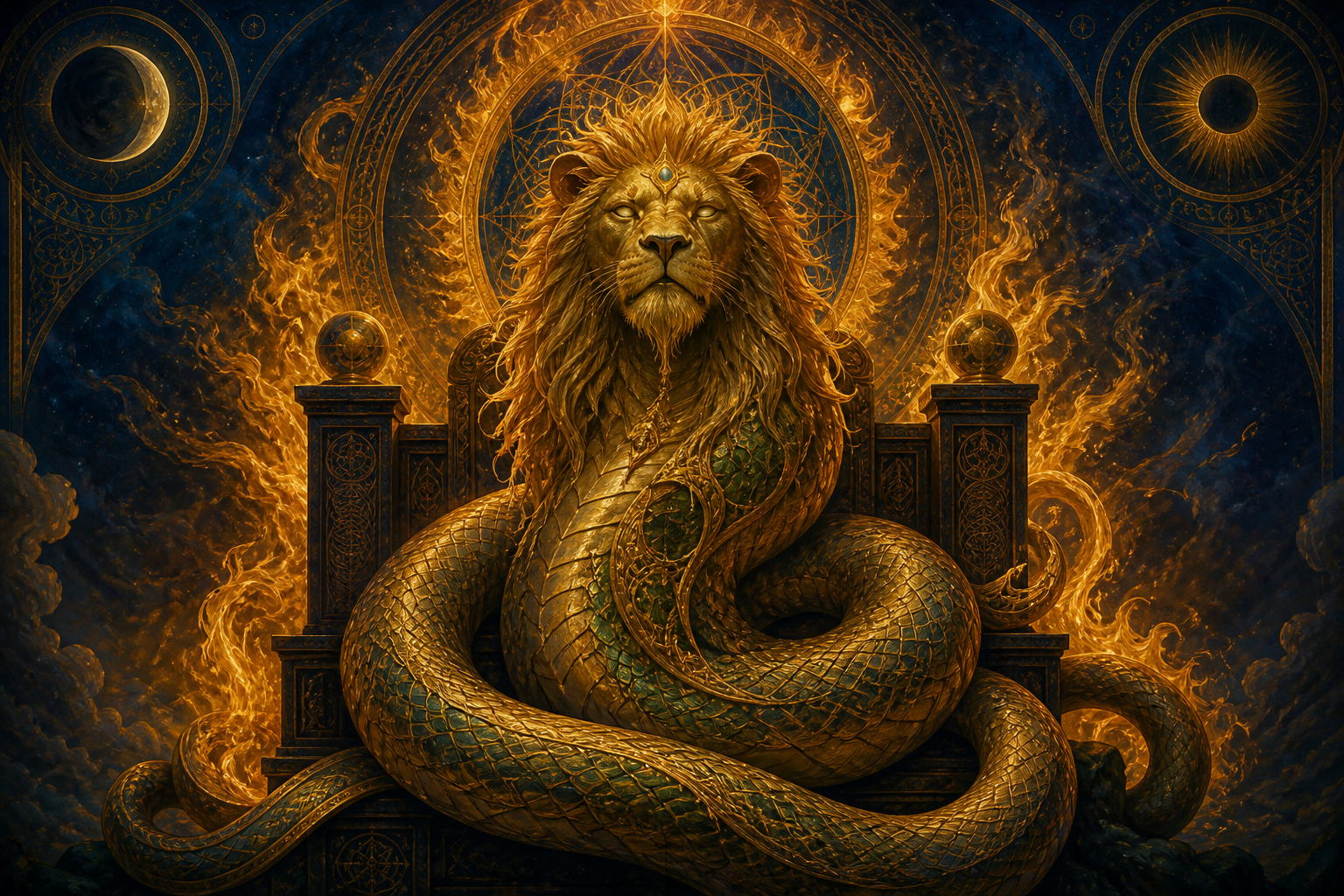
The imagery attached to him is consistent enough across sources to be significant: he is described as lion-faced and serpent-bodied, a hybrid of predator and coiling power, wreathed in fire. This is not idle monstrosity. The lion signals devouring appetite and the pride of rulership; the serpent signals the coils of fate and the earthbound. That several independent witnesses report the same composite image (evidence class P2) suggests a stable iconographic tradition rather than a single author’s invention, and the Atlas volume of this Library charts the variants side by side rather than merging them.
His defining utterance is the hinge of the whole Gnostic critique: “I am God, and there is no other beside me.” In the sources this is not a statement of sovereign truth but the fundamental error — the boast of a being who does not know that a fullness of light exists above him, who mistakes his derived and partial power for the whole of reality (evidence class P1). The tradition treats this sentence with deliberate provocation, because it echoes lines from the Hebrew scriptures; the Gnostic point is not that those scriptures are worthless but that a lower power has claimed for itself an ultimacy that belongs only to the unknowable Source.
It is essential to state clearly what this claim is and is not, because it is easily misread. The Gnostic reading of the creator-ruler is a theological and mythological critique of a certain image of God — the jealous, ignorant, dominating deity who demands obedience and obscures the truth of origins. It is emphatically NOT a claim about any living person, ethnic group, or contemporary religion, and this Library repudiates absolutely any attempt to read the archon myth as a slur against Judaism or any people (a distortion the ancient polemicists themselves sometimes courted and which this project rejects). The archon is a figure of a pattern, not a people.
Yaldabaoth’s blindness is, finally, the key to his power and to its undoing. He rules by ignorance — his own and the ignorance he propagates. He does not know where his power came from; he does not know it is borrowed; he does not know he can be seen through. The whole liberating movement of the tradition is a movement from his darkness toward knowledge, and the reason his authority can be broken at all is that it rests on a lie he himself believes. To know his name and his nature is already to have begun to step outside his jurisdiction. The chapters that follow anatomize that jurisdiction so that it can be recognized and, in the tradition’s terms, transcended.