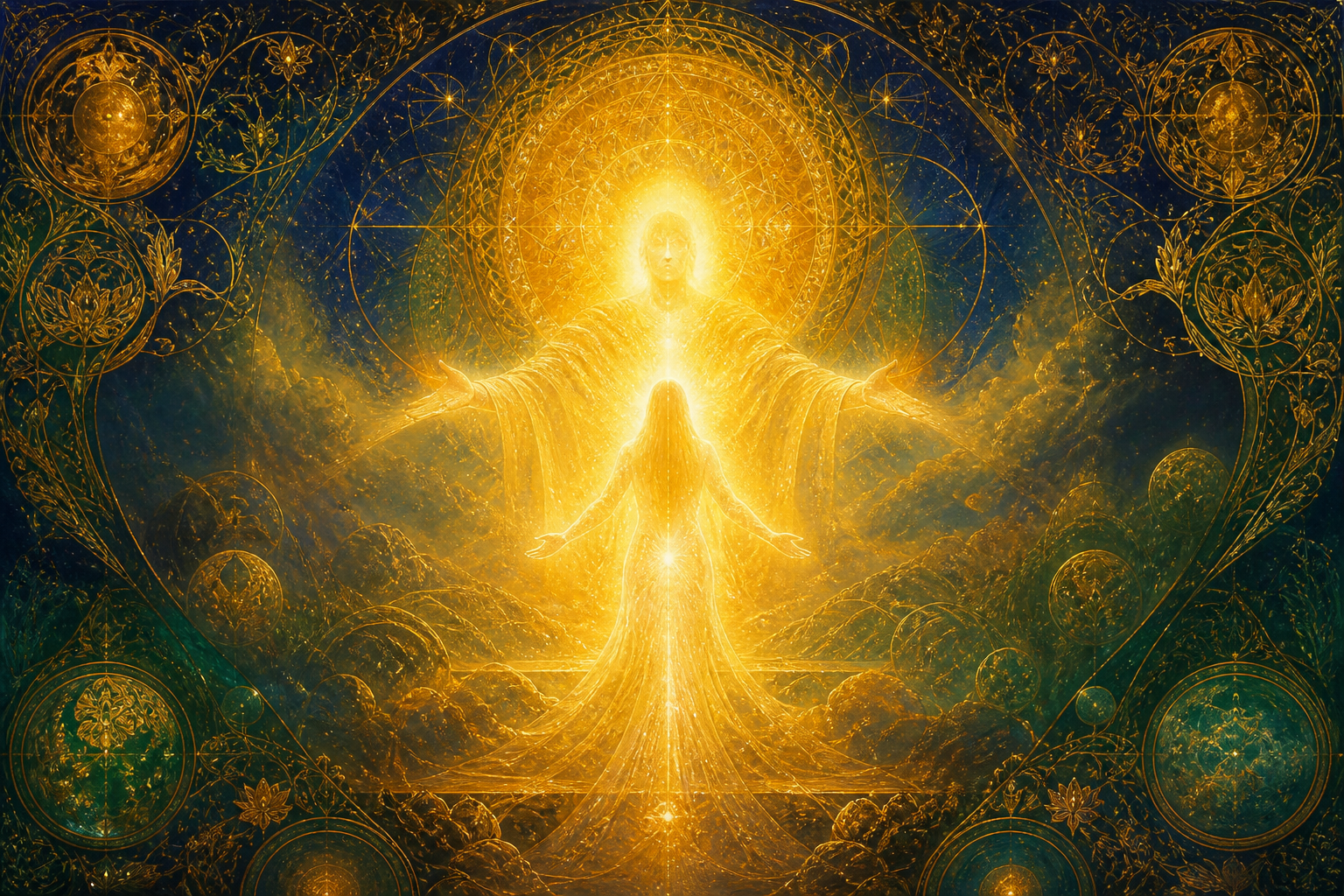
The Gospel of Remembering

Gnosis, Unforgetting, Awakening, Ascent, and Practical Contemplative Application

Gnosis is not knowledge about something — it is the recognition of who you already are.

Book 5 of 7

This book defines gnosis as transformative recognition rather than the possession of secret trivia. It catalogs the calls, prayers, hymns, baptismal seals, ascent responses, and contemplative instructions found across the Gnostic corpus, providing historical context, performance notes, and carefully labeled modern adaptations.

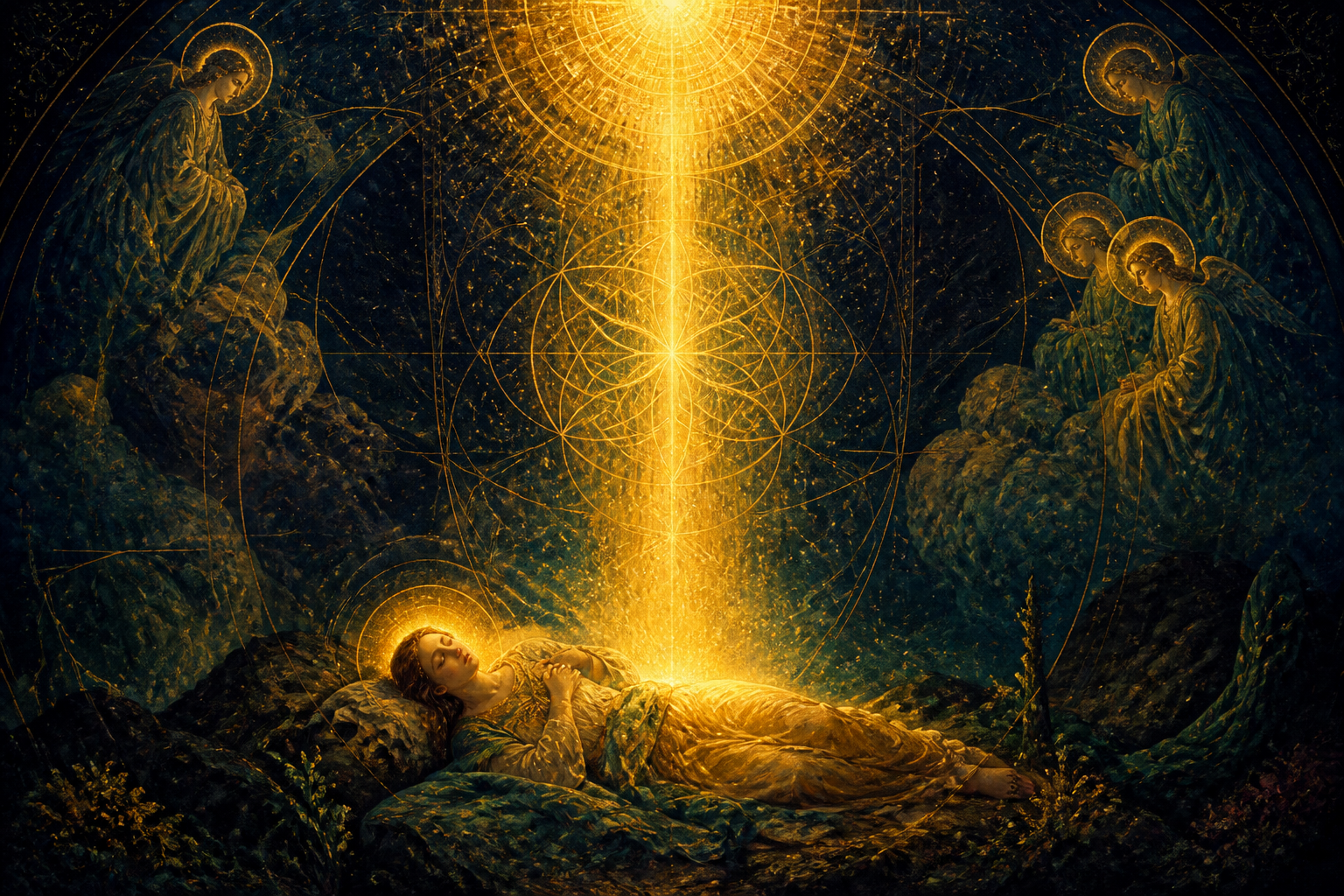
A beam of golden light descending from above to reach an awakening figure as dawn breaks the dark
The call — the divine voice reaching down into forgetting to awaken the sleeping.

1.What Is Gnosis?

3 min
P1C

Transformative recognition versus mere information. The distinction between knowing about the divine and recognizing one’s own origin, condition, and destination.

The word at the center of this entire Library is gnosis, and it is almost universally mistranslated. Rendered flatly as “knowledge,” it suggests information — facts about the divine, secret doctrines, hidden data available only to initiates. This chapter argues, with the sources, that gnosis means something quite different: transformative recognition, the kind of knowing that changes the knower. It is closer to how we “know” a face, a home, or a truth about ourselves than to how we know a fact (evidence class P1 for the usage; evidence class C for the interpretive framing).

The distinction is not pedantic; it is the hinge on which the whole tradition turns. To know about the divine origin of the soul, as a proposition one could affirm or deny, is not gnosis and saves no one — the rulers themselves, in the myth, possess plenty of information. Gnosis is the recognition of one’s own origin, condition, and destination: the direct, transformative seeing that I came from the light, that I have been asleep in forgetting, and that I am called to return. It is knowledge that is simultaneously self-knowledge and knowledge of God, because in this tradition the deepest self and the divine light are, at the root, one (evidence class P1).

The Gospel of Truth captures the quality of this knowing better than any definition. It speaks of the one who possesses gnosis as someone who was asleep and has awakened, who was drunk and has become sober, who was scattered and has been gathered — not someone who has acquired a new set of beliefs but someone whose whole condition has changed. Gnosis is described there as a return to the Father that is also the discovery of what one always already was. The text’s language of waking, sobering, and remembering tells us we are dealing with a transformation of the knower, not an addition to their store of facts.

This is why the tradition can say, provocatively, that gnosis is salvation — not because knowing the right doctrine earns rescue, but because the recognition itself is the rescue. The predicament, in the myth, is forgetting; the light in the soul has fallen asleep to its own nature and identified with the counterfeit self the rulers fashioned. The remedy for forgetting is remembering. When the soul recognizes what it truly is, the misidentification that constituted its bondage dissolves. Salvation is not a transaction that follows upon knowledge; it is the recognition itself, doing its work (evidence class C for this synthesis of the sources’ language).

The chapter closes by setting the reader’s expectations for the whole book, and for the practice it will describe. If gnosis were information, this book could simply deliver it and be done. Because gnosis is recognition, no book can hand it over; a book can only point, remind, and prepare the ground. The calls, hymns, seals, and contemplative instructions catalogued in the chapters that follow are all, in the end, instruments of pointing — ancient means by which the tradition tried to occasion the recognition it could not manufacture. The reader is warned, gently, not to mistake the pointing finger for the moon: to have read about gnosis is not yet to have remembered, and the difference between them is the whole of the path.

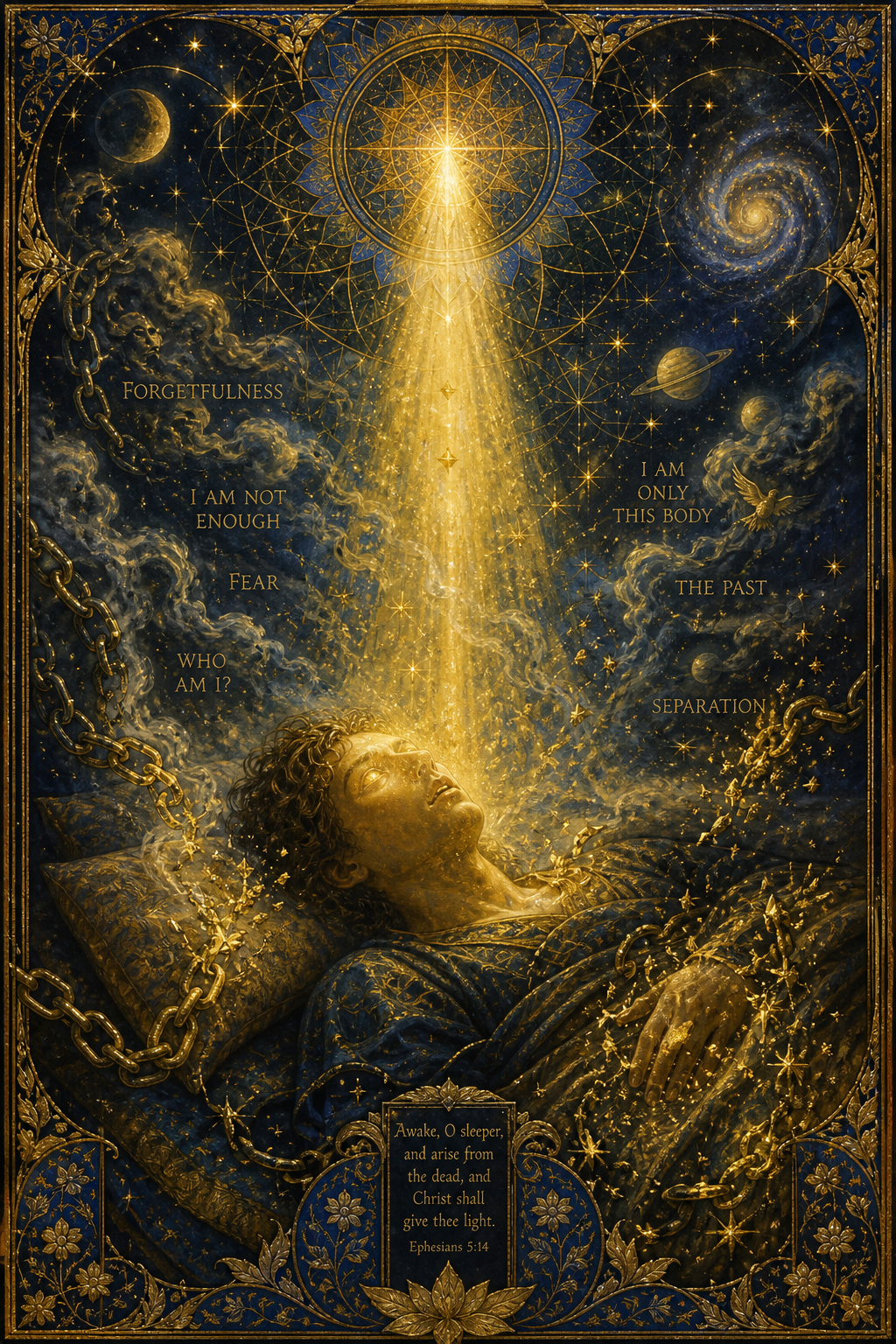
A solitary human figure enclosed within a lattice of geometric lines and chains of stars, yearning upward
The counterfeit cosmos — the soul bound by matter and fate.

2.Forgetfulness, Sleep, Drunkenness, Error

3 min
P1P2

The vocabulary of lostness across the Gospel of Truth, Apocryphon of John, and Exegesis on the Soul — is ignorance a substance, a condition, an error, sleep, or separation?

Before remembering can be understood, the condition it remedies must be named, and the Gnostic corpus names it with a rich and precise vocabulary of lostness: forgetfulness, sleep, drunkenness, error, ignorance, deficiency, scattering, and captivity. This chapter surveys that vocabulary across the Gospel of Truth, the Apocryphon of John, and the Exegesis on the Soul, and asks a genuine question the texts do not fully resolve: is ignorance a substance, a condition, an error, a sleep, or a separation? (evidence class P1 for the terms; evidence class P2 for the convergence of the imagery).

The Gospel of Truth speaks of Error as almost a personified power — a fog or cloud that arose because of ignorance of the Father, within which the beings of the lower world became lost and afraid. Here lostness is nearly a substance, a mist that must be dispelled. Yet the same text also speaks of forgetting as something that simply ceases when the truth appears, “like a nightmare from which one wakes,” suggesting that ignorance has no substance of its own at all and vanishes the instant knowledge comes. The tension is real and the text holds both images without resolving them.

The Apocryphon of John leans on the imagery of sleep and the counterfeit spirit: the soul is put to sleep, not the sleep of rest but the sleep of forgetting, and a false interior counterpart keeps it dreaming the rulers’ dream. The Exegesis on the Soul, by contrast, tells the condition as a story of separation and defilement — the soul as a fallen woman, wandering, prostituted to false lovers, until she remembers her origin, repents, and is restored to her true bridegroom. Sleep, defilement, exile: each metaphor carries a slightly different diagnosis of what has gone wrong (evidence class P1 for each).

The metaphor of drunkenness deserves its own note, because it is among the tradition’s most psychologically acute. To be drunk is not to be absent but to be present in a distorted way — awake yet not lucid, acting yet not clearly seeing, convinced of things that sobriety would dissolve. The Gospel of Truth’s image of the world as intoxicated captures how the condition of forgetting is not mere blankness but an active, plausible, self-confirming distortion. The forgetful soul does not experience itself as forgetting; it experiences itself as normal. This is precisely what makes the condition hard to escape and easy to deny.

The chapter’s honest conclusion is that the tradition offers not one doctrine of ignorance but a family of overlapping images, and that this multiplicity is itself instructive. Whether ignorance is a mist to be dispelled, a sleep to be woken from, a drunkenness to be sobered out of, or a separation to be healed, the common structure is clear: the condition is not the soul’s true nature but an overlay, and it is remediable. The differences among the images matter for how one understands the remedy — dispelling, waking, sobering, returning — but they converge on a single hope, that the lostness is not final and that what was forgotten can be remembered.

A beam of golden light descending from above to reach an awakening figure as dawn breaks the dark
The call — the divine voice reaching down into forgetting to awaken the sleeping.

3.The Call and the Awakening

3 min
P1

How the divine voice reaches into forgetfulness: the Pronoia hymn’s triple descent, the call of the living Jesus, Thunder’s paradoxical self-revelation.

If the human condition is forgetting, then salvation must begin from beyond the forgetting — for a soul asleep cannot wake itself, and a soul in a mist cannot see to find the edge of it. The tradition answers this with its great theme of the call: the divine voice that reaches down into forgetfulness from outside it, to awaken what cannot awaken itself. This chapter gathers the tradition’s calls — the Pronoia hymn’s triple descent, the call of the living Jesus, and the paradoxical self-proclamation of Thunder, Perfect Mind (evidence class P1 for each source).

The Pronoia hymn, appended to the longer recension of the Apocryphon of John, is the purest expression of the motif. In it the divine Forethought speaks in the first person of descending three times into the darkness of the lower world — into the midst of the prison, into the depths — to awaken the sleeping and remind them of their origin. “I entered into the midst of their prison... and I said: Whoever hears, let him arise from the deep sleep.” The threefold descent is deliberate and patient: the call comes not once but again and again, until it is finally heard (evidence class P1; the triple structure is developed in the Atlas volume).

The call of the living Jesus, across the corpus, functions the same way: the revealer descends in a form the sleeping can perceive and speaks the word that wakes them. In these texts salvation is emphatically a summons before it is a doctrine — a voice that says, in effect, “Wake up; remember; you are not what you have taken yourself to be.” The one who is saved is the one who hears and rises. This is why the tradition’s literature is so full of calls, cries, and awakening words: the whole drama turns on whether the summons reaching down into the forgetting will be heard.

Thunder, Perfect Mind adds a startling variation. In this text a feminine divine voice proclaims herself in a torrent of paradoxes — “I am the first and the last... I am the whore and the holy one... I am the silence and the voice.” The self-proclamation confounds every category by which the listener might try to place and thereby dismiss her; it forces recognition rather than mere classification. Read as a call, Thunder works by breaking the listener’s confident sorting of reality into high and low, honored and shamed — the very sorting the rulers depend on — so that a deeper recognition can break through (evidence class P1 for the text; evidence class C for reading it as a call).

The theological point beneath all three is that the initiative in salvation belongs to the light, not to the sleeper. This is one of the tradition’s most hopeful teachings and one of its most easily misunderstood. It does not mean the sleeper is passive — the call must still be heard, and hearing is a real act. But it means no one has to generate their own awakening out of the resources of the forgetting, which by definition they lack. The light comes down; the voice speaks first; the descent of the call precedes and enables the ascent of the soul. Grace, in a word, comes first — and the reader who feels unable to save themselves is told, precisely, that they were never meant to do it alone.

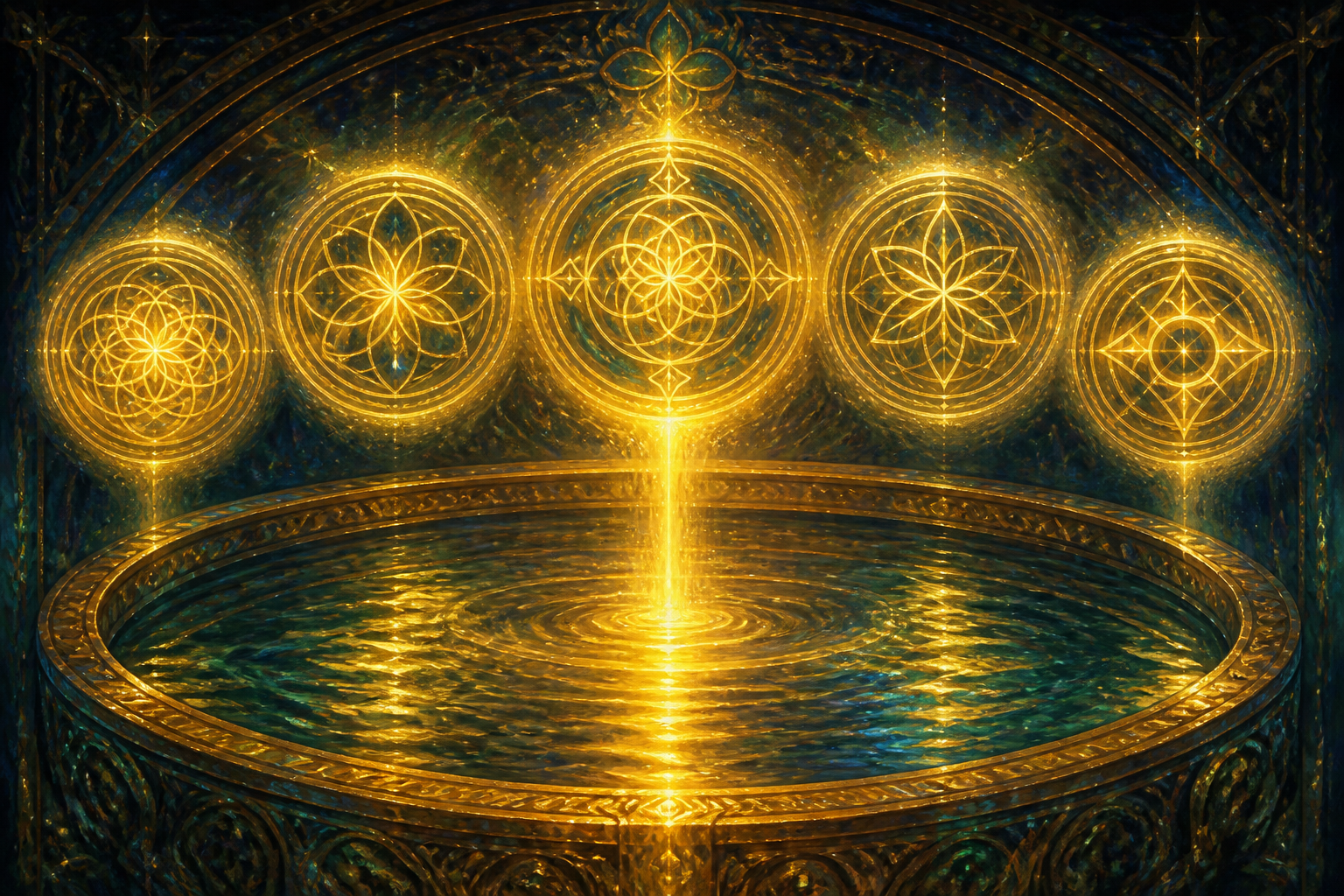
Sacred baptismal water reflecting light, with five radiant abstract seals of sacred geometry floating above
The Five Seals — the Sethian mystery of sealing the awakened to the light.

4.The Five Seals and Sethian Baptism

3 min
P1H

The baptismal rites described in the Apocryphon, Gospel of the Egyptians, and related texts — what the five seals sealed, and how initiates were transformed.

The tradition did not leave awakening to spontaneous insight alone; it developed rites, and the most important of the Sethian rites is the sealing described as the Five Seals. This chapter examines the baptismal practice referenced in the Apocryphon of John, the Gospel of the Egyptians, Trimorphic Protennoia, and related texts, and asks the honest questions the sources only partly answer: what were the five seals, what did they seal, and how were initiates transformed by them? (evidence class P1 that the rite existed and was central; evidence class H for its reconstruction, since no source gives a complete ritual manual).

What can be said with confidence is that the Five Seals were a baptismal rite of the Sethian Gnostics, understood as far more than a washing. The language surrounding them is language of enrobing in light, of being sealed so as to belong to the light and to be beyond the rulers’ reclaiming, of the five seals as a kind of spiritual armor and identity-mark for the ascending soul. In Trimorphic Protennoia the descending Protennoia describes giving the five seals to those she awakens, so that “death will have no power over them.” The seals mark the transition from the rulers’ jurisdiction to the light’s (evidence class P1).

Beyond this, reconstruction must be cautious, and this book is explicit about the limits. Scholars have proposed that the five seals correspond to a fivefold ritual sequence — perhaps immersions, anointings, or invocations of the five luminaries (Harmozel, Oroiael, Daveithai, Eleleth, and the fifth) — but the sources do not give us a stage-by-stage liturgy, and honest scholarship marks the details as inferred. This Library presents the leading reconstructions as reconstructions, clearly labeled, and refuses to fabricate a detailed ceremony the texts do not preserve. What the seals sealed is clearer than exactly how they were administered.

The transformation the rite effected can be described in the tradition’s own terms. To be sealed was to be re-identified — no longer as a being of the rulers’ world, subject to fate and death, but as one belonging to the light, marked as the light’s own. The rite enacted outwardly the inward recognition that is gnosis: it made visible, communal, and durable the awakening that might otherwise remain a private flash. Baptism in this tradition is thus not the washing away of moral guilt in the conventional sense but the sealing of a changed identity, the ritual counterpart of remembering who one is (evidence class H for this interpretation).

For the modern reader, the chapter draws a careful line. The Five Seals belonged to a living community with practices we can only partly recover, and this book does not offer a do-it-yourself reconstruction presented as the authentic ancient rite — to do so would violate the Library’s standard against fabricated authority. What it offers instead is understanding: of why a tradition of recognition nonetheless needed ritual (because human beings are embodied, communal, and forgetful, and need acts that mark and hold transformations), and of what such a rite meant to those who received it. Where later chapters describe contemplative adaptations, they will be labeled MODERN RECONSTRUCTION and never confused with the ancient seals themselves.

Sacred baptismal water reflecting light, with five radiant abstract seals of sacred geometry floating above
The Five Seals — the Sethian mystery of sealing the awakened to the light.

5.The Bridal Chamber and Valentinian Sacrament

3 min
P1H

The Gospel of Philip’s sacramental theology: baptism, anointing, eucharist, redemption, and the bridal chamber as reunion of separated halves.

Where the Sethians had the Five Seals, the Valentinians had a richer sacramental system, and at its summit stood the mystery of the bridal chamber. This chapter turns to the Gospel of Philip, our fullest source for Valentinian sacramental theology, which names a sequence of mysteries — baptism, chrism (anointing), eucharist, redemption, and the bridal chamber — and treats the bridal chamber as the highest (evidence class P1 for the list; evidence class H for its interpretation, since the Gospel of Philip is a collection of reflections rather than a systematic treatise).

The bridal chamber is best understood through the tradition’s myth of separation and reunion. In the Valentinian reading of Genesis, the primordial division of the human into male and female was a fall into separation, a splitting of an original unity; and the deepest problem of the human condition is precisely this dividedness. The bridal chamber is the sacrament of reunion — the ritual and mystical restoration of the separated halves, the rejoining of the soul with its angelic counterpart or spiritual complement, the healing of the original split. “If the woman had not separated from the man, she would not die with the man,” the Gospel of Philip says; the bridal chamber undoes the separation (evidence class P1).

It is crucial to state, against a long history of prurient misreading, that the bridal chamber is not straightforwardly a sexual rite, and the Gospel of Philip itself distinguishes the “defiled” marriage of the world from the “undefiled” marriage of the mystery. The nuptial imagery is the tradition’s chosen metaphor for the most intimate possible reunion — the joining of the soul with its divine source or counterpart — and reading it as literal ritual intercourse repeats exactly the sensationalizing error that this Library warns against throughout. The evidence points toward a mystery of spiritual union for which marriage is the image, not the mechanism (evidence class H, with the sexualized reading flagged as class U and probably distorted).

The other sacraments form a graded path toward this summit. Baptism cleanses and initiates; the chrism anoints with the Spirit and, in some passages, is exalted even above baptism; the eucharist nourishes with the light; redemption prepares and liberates; the bridal chamber consummates. The Gospel of Philip presents these not as mechanical steps but as deepening participations in the reality they signify — “the Lord did everything in a mystery, a baptism and a chrism and a eucharist and a redemption and a bridal chamber.” The sacraments make present, in enactable form, the recognition and reunion that constitute salvation.

The chapter closes by drawing the Sethian and Valentinian rites together without collapsing their real differences. Both traditions understood that gnosis, though it is inward recognition, seeks embodiment in act, community, and mystery — that human beings need rites to mark, hold, and deepen what they have recognized. The Five Seals sealed a changed identity against the rulers; the bridal chamber healed the primordial separation into reunion with the source. Different myths, different ceremonies, one underlying conviction: that the light’s awakening in a person is meant to be not merely thought but enacted, and that the enactment, rightly understood, is itself a participation in the return.

A small figure of light ascending a luminous stair rising through layered heavens toward a radiant summit
The ascent — the soul’s return home through the heavens.

6.Ascent Narratives and Passage Through the Heavens

3 min
P1C

Zostrianos’s visionary ascent, the Books of Jeu’s passwords and seals, and the Pistis Sophia’s repentance hymns — maps of return through hostile territory.

The soul that has been called, sealed, and awakened must still make the journey home — and in the Gnostic imagination that journey is an ascent through the heavens, back up through the very spheres of the rulers by which it descended. This chapter maps the ascent narratives: the visionary ascent of Zostrianos, the passwords and seals of the Books of Jeu, and the repentance hymns of the Pistis Sophia. Each is a map of return through hostile territory, and the maps differ enough that the Atlas volume draws them separately rather than merging them (evidence class P1 for each; evidence class C for the comparison).

Zostrianos records a visionary ascent in the first person — the seer rises through successive levels of reality, is baptized at each, receives instruction from the powers of light who dwell there, and ascends toward the Barbelo-aeon and the invisible Spirit. The text is fragmentary and philosophically dense, heavy with the technical vocabulary of the aeons, but its structure is clear: ascent is graded, each level has its guardians and its lessons, and the seer is progressively transformed as he rises. Ascent here is less an escape than an education — a passage upward that is also an initiation into ever higher orders of reality.

The Books of Jeu take a different, more operational form: they supply the ascending soul with the names, seals, and passwords required to pass each gate. To ascend, in this literature, is to face at each threshold a guardian who must be answered rightly — with the correct name, the correct seal, the correct defense — or the soul is turned back. This is the tradition’s ascent as ritual knowledge: salvation depends in part on knowing the map and its passwords, which is why the texts preserve them. The Library presents these as the tradition’s own account of the ascent, without claiming they constitute a working procedure for a modern reader (evidence class P1 for the material; the operational claim marked as the texts’ own).

The Pistis Sophia offers yet another key: the repentance hymns. In this long and intricate text, the fallen Sophia, trapped in the lower regions, sings a series of repentances — cries of longing, confession, and appeal to the light — and is answered, stage by stage, as the light draws her upward. Her ascent is powered not by passwords but by the movement of the heart: repentance, longing, and trust. This is the ascent moralized and interiorized — the passage upward as a transformation of desire, the soul drawn home by the reorientation of its love toward the light (evidence class P1).

Taken together, the ascent narratives describe the same return in three registers — visionary, ritual, and devotional — and the chapter resists forcing them into one. What they share is the conviction that return is real, that it passes back through the very structures that bound the soul, and that it transforms the soul as it goes. What they teach differently is how return is accomplished: by rising through levels of insight, by knowing the map and its defenses, or by the reorientation of longing. The reader is offered all three as the tradition’s own repertoire, and reminded that ascent, in the tradition’s deepest logic, is finally the outward image of an inward remembering — the light returning, through whatever heavens, to the recognition of where it truly belongs.

A single radiant point of golden light in dark cosmic space, sacred-geometry rings emanating outward
The Monad — the unknowable Source, the one light from which all fullness flows.

7.Contemplative Practices: Ancient Sources and Modern Reconstruction

3 min
P1H

A catalog of attested practices with source, purpose, and uncertainty — plus clearly labeled MODERN RECONSTRUCTION adaptations that honor the original intent without claiming ancient authority.

This chapter is the most delicate in the book, because it moves from describing what the ancient sources say to considering what a person today might actually do — and the Library’s editorial standard governs every line of it. The chapter catalogs the contemplative practices attested or implied in the corpus, always with source, purpose, and honest uncertainty; and where it offers adaptations for modern use, it labels them unmistakably as MODERN RECONSTRUCTION, never as the recovered ancient rite (evidence class P1 for the attested practices; evidence class H for their reconstruction).

The attested practices cluster into recognizable kinds. There is recitation and hearing of the sacred texts — the calls, hymns, and revelations meant to occasion recognition. There is invocation — the speaking of divine names and the addressing of the powers of light. There is the sacramental and ritual life described in the previous chapters. There is silence and interior attention, implied by the contemplative density of texts like the Three Steles of Seth, which read as ascending doxologies meant to be prayed. And there is ethical purification — the stripping off of the passions — understood as a practice, not merely a state (evidence class P1 for these categories, with varying certainty about the details).

The Three Steles of Seth reward particular attention as a witness to Gnostic prayer. The text is structured as three ascending hymns of praise — to Autogenes, to Barbelo, and to the pre-existent One — rising through the levels of reality in adoration and returning. Scholars read it plausibly as a liturgical text meant to be recited by a community ascending in contemplation, with the descent back to ordinary awareness marked at the end. It gives us a rare, concrete glimpse of what Gnostic contemplative practice may have felt like from the inside: ascent through praise, and a deliberate return (evidence class H for this reading).

When the chapter turns to modern adaptation, it does so under strict rules that the reader should hold the book to. Any practice offered for contemporary use is presented as an adaptation honoring the original intent, not as a channeled or reconstructed ancient ceremony with claimed authority. No fabricated liturgy is dressed up as historical. Every adaptation is grounded, ethical, and framed as optional and experimental. And every one carries the same caution: these are contemplative and reflective practices, valuable as such, and they are never presented as a substitute for medical or mental-health care, nor as techniques that guarantee particular experiences.

The reason for this scrupulousness is not timidity but fidelity. A tradition whose whole burden is truth-telling and the exposure of counterfeit authority would be betrayed by a practice-chapter that manufactured ancient-sounding rites and sold them as recovered secrets — that would be to do exactly what the rulers, in the myth, do. So the chapter holds the line: here is what the sources actually attest; here is what we can responsibly reconstruct and what we cannot; here is how one might, today, honor the intent of these practices honestly. The next chapter distills this into a single, plainly labeled framework the reader can actually use — with the same cautions carried through.

A luminous figure returning home, merging into a great embrace of golden radiance
The return — the light’s homecoming, and the completion of the cycle.

8.The Practice Framework

3 min
S

Prepare → Ground → State intention → Recite/read → Silence → Interior attention → Ethical integration → Journal → Close → Return to ordinary activity. Grounding cautions and safety principles.

The book ends with a practice framework — a single, clearly labeled contemplative sequence that gathers the spirit of the attested practices into something a person today can actually do. It is offered as MODERN RECONSTRUCTION (evidence class S): not an ancient rite, but a responsible adaptation honoring the tradition’s intent of occasioning recognition. The sequence is simple and can be stated in a breath: prepare, ground, state intention, recite or read, fall silent, attend inwardly, integrate ethically, journal, close, and return to ordinary activity.

Each movement has a purpose drawn from the tradition. To prepare and ground is to arrive in the body and the present, establishing the stability without which contemplative attention becomes ungrounded — the opposite of the dissociation the Library everywhere warns against. To state intention is to orient the practice toward recognition rather than experience-seeking. To recite or read a call, hymn, or passage — the Pronoia hymn, a line from the Gospel of Truth, a stele — is to let the tradition’s own words do their work of pointing. These first movements settle and aim the attention before anything deeper is attempted.

The central movements — silence and interior attention — are where recognition, if it comes, comes. Here the practitioner simply attends: to the fact of awareness itself, to the light the tradition says is seeded within, to the difference between the passing contents of the mind (the installed reactivity, the counterfeit self) and the awareness in which they appear. Nothing is forced. The tradition’s insight is that gnosis cannot be manufactured, only prepared for; so the practice does not strain after a state but rests in an attention that leaves room for recognition to arise. This is contemplation, not technique-driven experience-hunting.

The closing movements — ethical integration, journaling, formal closing, and deliberate return to ordinary activity — are as important as the silence, and the Library insists on them. Ethical integration asks how the recognition, if any, should change one’s conduct toward others, since a gnosis that made one more contemptuous or withdrawn would be counterfeit. Journaling holds and clarifies. The formal close and the deliberate return to ordinary life — mirroring the descent marked at the end of the Three Steles of Seth — ensure the practitioner comes fully back, grounded, rather than leaving the practice in a dissociated haze. Return to the ordinary is not a falling-away from the practice; it is its completion.

The book’s final words are the cautions that make the framework safe to use, and they are not fine print but the heart of the matter. This is a contemplative and reflective practice, offered as reconstruction and never as guaranteed technique. It is not a substitute for medical or mental-health care, and anyone in distress should seek such care first. It should ground rather than destabilize; if it consistently produces fear, dissociation, or distress, it should be set aside. It is meant to make a person more awake, more grounded, more ethical, and more free — and by that fruit it should be judged. The Gospel of Remembering ends where it began: gnosis is recognition, recognition cannot be forced, and the whole of the practice is only the patient, honest preparation of the ground in which remembering may occur.

Key Primary Sources

Gospel of Truth
Trimorphic Protennoia
Gospel of Philip
Thunder, Perfect Mind
Zostrianos
Books of Jeu
Pistis Sophia
Three Steles of Seth
Apocryphon of John (Pronoia hymn)
Exegesis on the Soul

Search this book

Ask a question or enter a topic and this finds the exact passages in the text that answer it — quoted word-for-word with their source chapter. It searches the book’s real content, so it’s instant, always available, and free to use. Ask as many follow-ups as you like.

Try searching for:

Results are drawn only from the Library’s published text. Do not substitute spiritual practice for medical or mental-health care.