The Book of the Monad

The Invisible Spirit, Barbelo, First Thought, and the Aeons of the Pleroma

Before creation, before time — the Source that cannot be named contemplates itself into existence.

Book 2 of 7

An exploration of the highest levels of Gnostic cosmology: the Invisible Spirit beyond all description, Barbelo as the first self-expression and knowability of the unknowable, and the emanation of the aeons that constitute the Pleroma — the fullness of divine being. The book presents multiple cosmological maps rather than forcing diverse ancient systems into a single artificial scheme.

A single radiant point of golden light in dark cosmic space, sacred-geometry rings emanating outward
The Monad — the unknowable Source, the one light from which all fullness flows.

1.The Apophatic Source: What Cannot Be Said

3 min
P1C

Describing the Invisible Spirit through negation — not darkness, not light, not a god among gods. How Sethian and Valentinian texts approach the ineffable differently.

The Gnostic vision of ultimate reality begins not with a statement but with a refusal. The highest principle — the Invisible Spirit, the Monad, the One — is approached in the primary texts almost entirely through negation. The Apocryphon of John piles denial upon denial: the Invisible Spirit is not corporeal, not incorporeal in any way we could name, not great, not small, not a quantity, not a quality, not a god among gods. It is not even accurately called “it,” for it precedes the distinctions that make our pronouns possible. This is the apophatic (negative) theology in its most uncompromising form, and it is the necessary foundation for everything that follows.

The reason for the refusal is philosophical, not merely reverent. Anything we can name, we can name because it stands within a system of contrasts — light against dark, great against small, being against non-being. But the Source of all such systems cannot itself be one term in a contrast without ceasing to be the Source. To say the One “exists” in the same sense that creatures exist is already to have miscounted, to have placed the origin of being alongside the things it originates. The negations are not evasions; they are a discipline for keeping the mind from collapsing the infinite into an object it can handle.

The primary texts are explicit and remarkably consistent on this apophatic approach (evidence class P1), and the pattern converges across Sethian and Valentinian materials and beyond into the broader Platonizing philosophy of late antiquity (evidence class P2, shading into H for the philosophical genealogy). The Gnostic authors were not writing in a vacuum; they shared a conceptual world with Middle Platonists and later Neoplatonists who wrestled with the same problem of how the utterly simple One relates to the multiplicity of everything else. This shared background is important context and is flagged as such rather than presented as Gnostic invention.

Yet the Gnostic texts are not purely negative. Alongside the denials there is a cascade of superlative affirmations: the Invisible Spirit is the immeasurable light, the pure and boundless, the fountain of living water, the giver of all that is. This is the characteristic double movement of mystical theology — saying what cannot be said by both denying every limited predicate and affirming every perfection without limit. The reader who feels the language straining is feeling exactly what the authors intended: the strain of pointing beyond pointing, of gesturing toward what exceeds the gesture.

Why begin the whole cosmology here, in the difficult air of the ineffable? Because everything the tradition says afterward — about Barbelo, the aeons, Sophia, the descent, and the return — is an attempt to say how multiplicity and distance and eventually a flawed world could arise from, and find their way back to, a Source that is perfect, single, and beyond all distance. Get the Source wrong — make it a big powerful being, a cosmic manager, a god with moods — and the rest of the story becomes incoherent. The apophatic beginning is the anchor. This chapter asks the reader to sit with the unsayable before the sayable can mean anything.
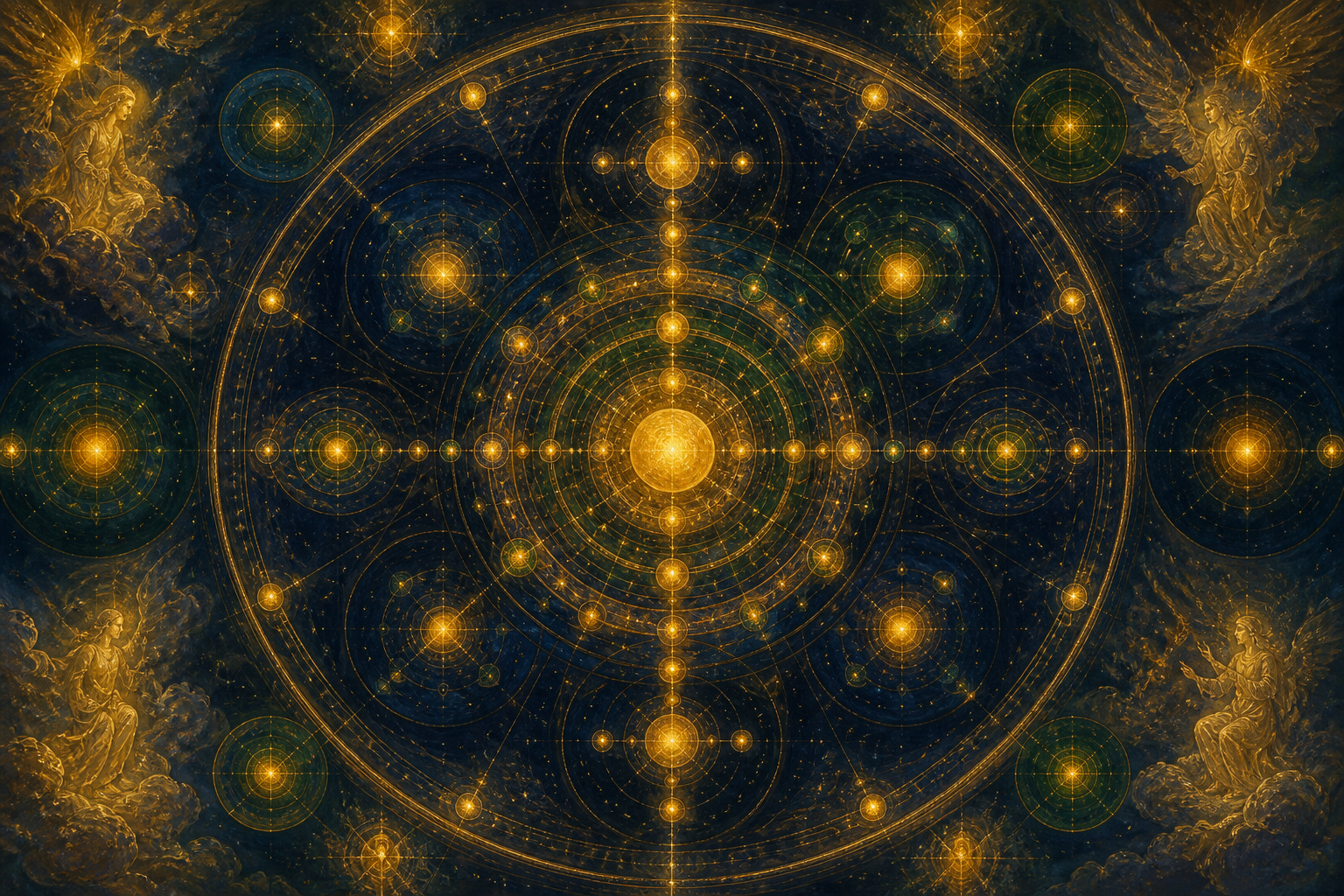
A luminous map of concentric spheres and paired points of light — the fullness of the aeons
The Pleroma — the fullness of the divine aeons.

2.Barbelo: First Thought, Foreknowledge, Womb

3 min
P1P2

Barbelo’s titles across the sources — Mother-Father, Triple-Powered One, First Human, Incorruptibility, Eternal Life, Truth — and what they reveal about the first act of divine self-knowledge.

If the Invisible Spirit is utterly beyond knowing, how can there be any knowledge of it at all — even the Spirit’s own self-knowledge? The Gnostic answer to this question is Barbelo. In the Apocryphon of John, the Invisible Spirit beholds itself in the pure light that surrounds it, and in that act of self-beholding there arises the first expression, the first knowability of the unknowable: Barbelo, the First Thought (Pronoia, Ennoia), the image of the invisible in which the invisible first becomes knowable to itself. Barbelo is not a second god but the Source’s own self-reflection made distinct — the first “other” that is still not truly other.

The titles heaped upon Barbelo in the primary texts are extraordinary and worth listing, because each names a facet of this first self-expression: First Thought, Forethought, the Womb of Everything, the Mother-Father, the Triple-Powered One, the First Human, Incorruptibility, Eternal Life, Truth. Barbelo is androgynous and generative, the matrix in which the whole realm of divine fullness will unfold. The abundance of titles is not confusion; it is the tradition’s way of indicating that Barbelo is the single point from which all the divine attributes will differentiate. The texts assert these titles directly (evidence class P1), and they recur with striking stability across the Sethian corpus (evidence class P2).

The relationship between the Invisible Spirit and Barbelo is the most delicate in all of Gnostic metaphysics, and the texts handle it with care. Barbelo does not diminish the Spirit or divide it; the Spirit remains one and undivided. Rather, Barbelo is the mode in which the One’s absolute simplicity opens toward self-knowledge without ceasing to be simple. Later philosophical language would speak of this as the emergence of Intellect from the One — the first differentiation that is not yet a fall, not yet a loss, but the necessary condition for there being any knowledge, any relationship, any love within the divine at all.

It matters, theologically and even psychologically, that the first movement of reality in this system is an act of self-knowing that is also an act of self-loving. The Source does not create out of need or lack; it beholds itself, and in that beholding the fullness begins. Everything downstream — including, eventually, the human capacity to remember and recognize — is a distant echo of this first recognition. When a human being awakens to their own true nature, they are, in the tradition’s deep logic, repeating in miniature the primordial act by which Barbelo arose from the Spirit’s self-regard.

Barbelo is also, and this is not incidental, a supremely feminine-maternal principle at the very top of the divine order — the Womb of Everything, the Mother of the living. In a religious landscape that increasingly imagined ultimate reality in exclusively masculine terms, the Sethian placement of Barbelo as the first self-expression of God is significant. This Library notes the point without overclaiming it: the texts are ancient, their symbolism is complex, and Barbelo is a metaphysical principle before she is anything a modern category could capture. But the maternal-feminine face of the divine fullness is genuinely there in the sources, and it is one of the tradition’s quiet gifts.

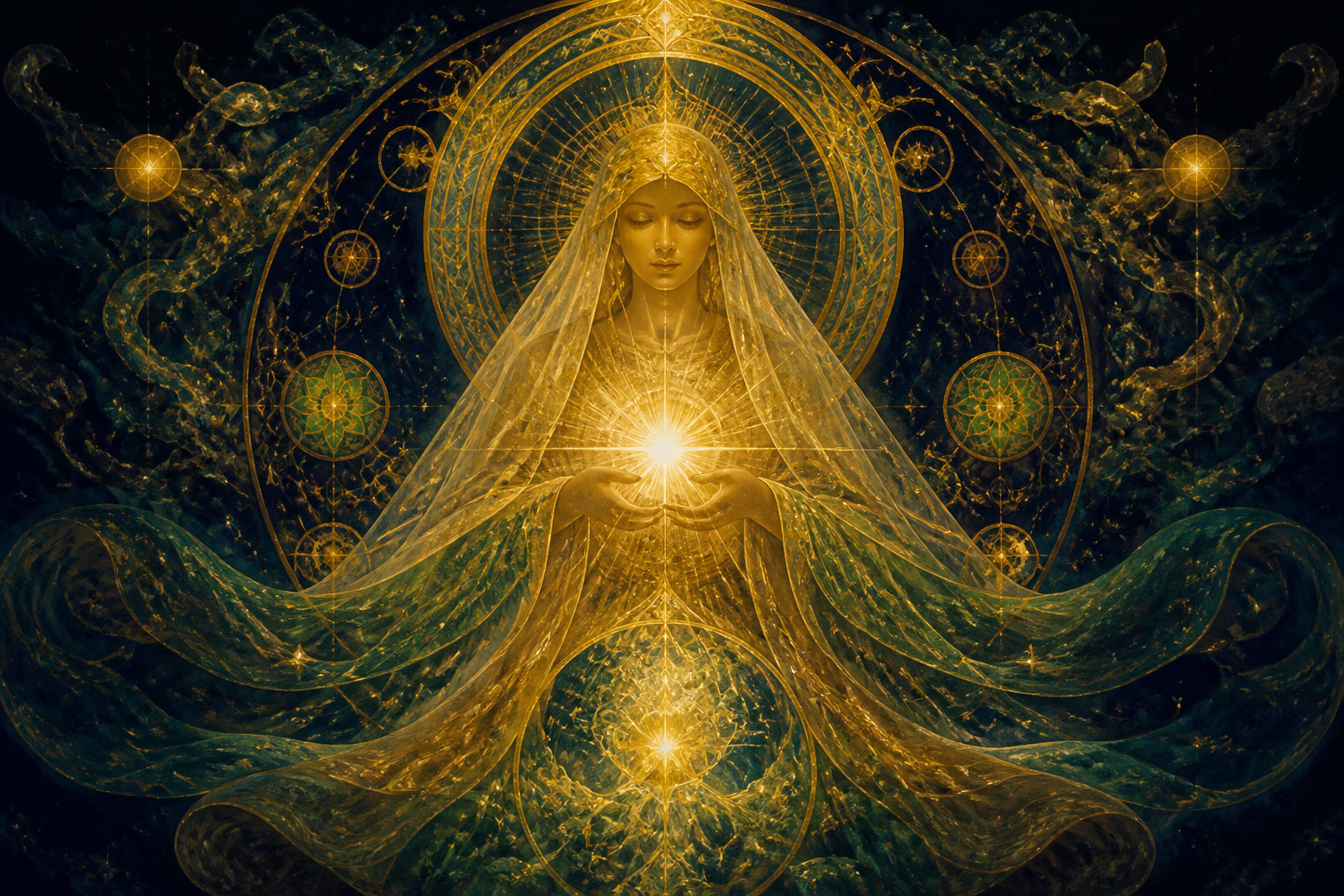
A luminous veiled feminine presence emerging as the first reflection of light within darkness
Barbelo — the First Thought, the divine world’s first self-reflection.

3.Emanation: How the One Becomes Many

3 min
P1C

Self-contemplation, request-and-consent, paired aeons, and the Valentinian syzygy model — comparing the mechanics of divine multiplication across schools.

From Barbelo the fullness unfolds, and the mechanism of that unfolding — how the One becomes many without ceasing to be One — is the subject of this chapter. The Gnostic texts describe emanation, not creation: the divine realm is not manufactured from outside but flows outward from within, each level arising from the contemplation and self-expression of the level above. Barbelo, gazing toward the Spirit, brings forth; what she brings forth gazes in turn and brings forth further; and so the aeons — the eternal realities that populate the fullness — come to be, generation upon generation, in an outflowing that is also a kind of luminous conversation.

The Sethian and Valentinian schools describe this process with different emphases, and the differences are instructive rather than embarrassing. The Sethian texts tend to present a sequence of emanations organized around Barbelo, the self-generated Christ (Autogenes), and the four Luminaries. The Valentinian systems, especially as reported by Irenaeus and reflected in texts like the Tripartite Tractate, prefer paired aeons — syzygies — in which each reality comes forth with its complement, male and female together, up to a total fullness often numbered at thirty. This book presents both models side by side (evidence class P1 for each within its own texts; evidence class C for the comparison) and resists the old scholarly urge to declare one the “original” and the other a corruption.

The syzygy model deserves special attention because it encodes a profound intuition: that reality at its source is relational, that nothing in the fullness stands alone, that even the divine attributes come in complementary pairs whose union is their perfection. Depth and Silence, Mind and Truth, Word and Life, Human and Church — the Valentinian pairs read almost like a philosophy of love, in which to be is to be with, and separation is the beginning of deficiency. This intuition will matter enormously later, when Sophia’s act is described as, among other things, a movement undertaken without her partner — a reaching that broke the pattern of pairing.

A recurring motif in the emanation accounts is request-and-consent: a lower reality asks the Spirit’s permission before bringing forth, and the bringing-forth is accompanied by praise and glad assent from the whole fullness. This is not idle narrative decoration. It establishes the norm against which Sophia’s act will be measured. In the well-ordered emanation, nothing acts alone, nothing acts without consent, nothing reaches beyond its proper relation. The fullness is a harmony of glad agreements. When something goes wrong, it will go wrong precisely as a breach of this pattern — an act undertaken alone, without consent, reaching past the proper boundary.

The philosophical stakes of the emanation model are worth making explicit. Emanation solves, or at least addresses, the problem that will drive the entire drama: how can a perfect and single Source be compatible with a world of multiplicity, distance, and eventually deficiency? The answer is that multiplicity arises by outflowing degrees, each further from the simple unity of the Source, until at the far edge of the fullness the possibility of real distance — and therefore of real rupture — first appears. The aeons nearest the Source are secure in their unity; it is at the boundary, in the youngest and most distant aeon, that the story’s crisis becomes possible. That aeon is Sophia, and the fullness has been quietly preparing us to understand her.

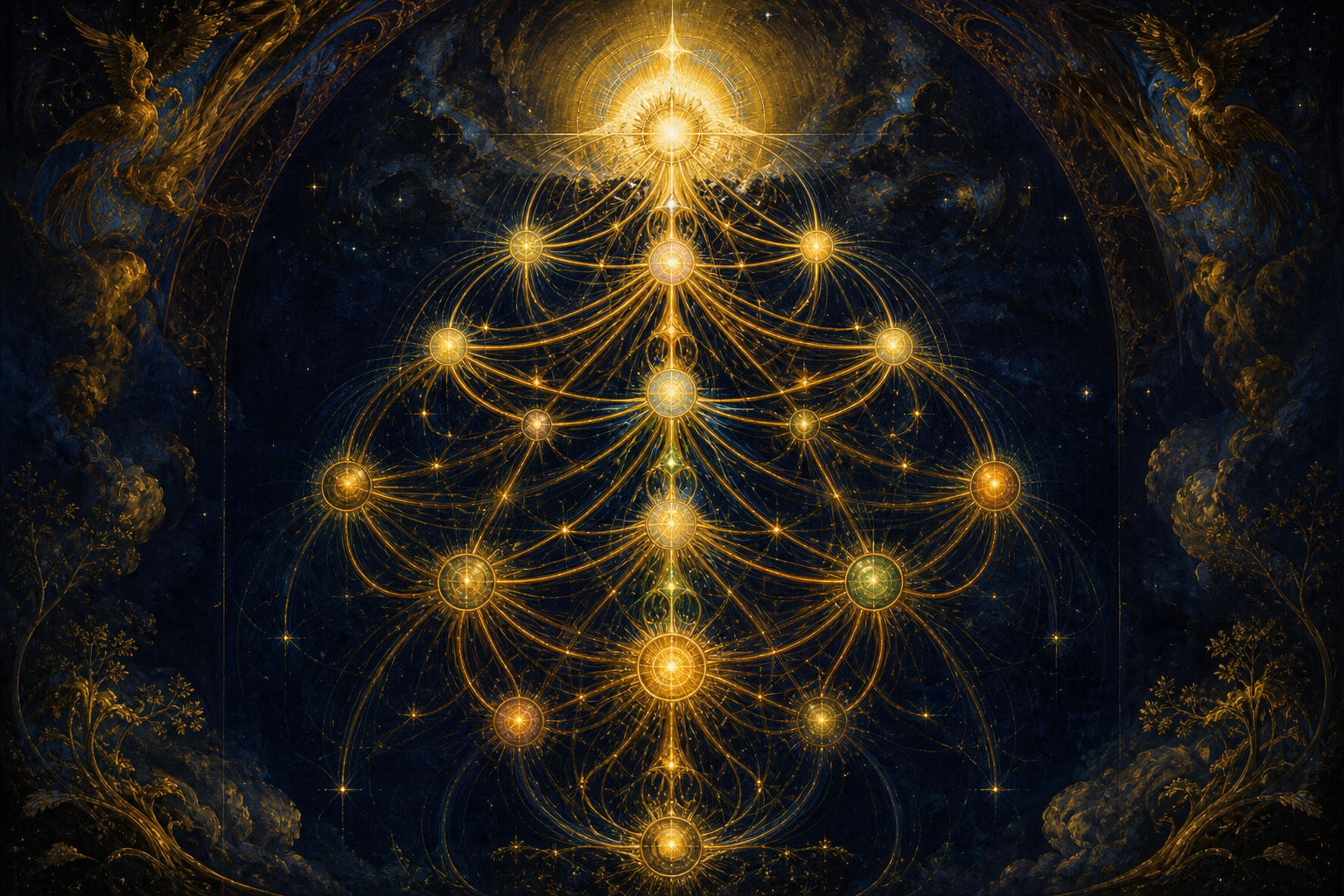
An abstract tree of light: branching gold lines connecting glowing nodes descending from a crown of light
The unfolding — emanation of the aeons from the Source (uncertainty in the outer branches).

4.Silence, Thought, Voice, Word, Name

3 min
P1H

The relationship among these primordial powers and how they map to stages of divine self-disclosure — the architecture of knowability itself.

Among the earliest and most mysterious of the divine realities are a cluster of powers whose names describe the stages of self-disclosure itself: Silence, Thought, Voice, Word, and Name. These are not arbitrary personifications. They map, with real philosophical precision, the sequence by which the ineffable moves toward expression — from the utter Silence that precedes all utterance, through the inward Thought that first stirs, to the Voice that breaks the silence, the Word that gives the voice content, and the Name that makes the content knowable and invocable. This chapter traces that sequence as the architecture of knowability.

The Trimorphic Protennoia is the great text here, and it is remarkable: the First Thought speaks in the first person, describing her own threefold descent as Voice, then Speech, then Word. “I am the Voice,” she says, and later “I am the Word.” The text stages the very process by which the unsayable becomes sayable, and it does so from the inside, as autobiography. The primary text is explicit and sustained (evidence class P1), and the Voice-Speech-Word progression aligns closely with the Silence-Thought-Word sequence found elsewhere (evidence class P2), suggesting a shared and stable model of divine self-expression across the Sethian materials.

Why does this matter beyond its intrinsic beauty? Because it establishes that expression — speech, word, name — is not a fall from silence but silence’s own fulfillment. The Voice does not betray the Silence; it carries it outward. This has direct consequences for how the tradition understands revelation and, eventually, salvation. The call that reaches into human forgetfulness — the summons to wake up and remember — is the same divine self-expression that first broke the primordial silence. When a human hears, at the depth of themselves, a voice that seems to know their true name, the tradition would say they are hearing a late and personal instance of the First Thought’s ancient speech.

The power of the Name is a theme easy for modern readers to underestimate, because we tend to treat names as arbitrary labels. Ancient thought, Gnostic and otherwise, treated the true name as participating in the reality it names — to know a thing’s true name was to have a real relation to it, even a kind of power. This is why the ascent texts we will meet in later books are so preoccupied with names, passwords, and seals: to pass a guardian power is to know its name, and to be known by the higher realm is to have one’s own true name spoken. The sequence that ends in Name ends, that is, in the possibility of real relationship and real return.

This chapter, then, is a bridge. It connects the metaphysics of the Source and Barbelo to the drama of descent and recovery that the rest of the Library narrates. The whole story can be read as a story about speech and hearing: the divine Silence learning to speak, the speech reaching down into a world of forgetfulness, and the forgetful hearing at last the Word that names them and calls them home. The architecture of knowability built in the fullness is the same architecture along which, much later and much lower, a single human being comes to recognition. Nothing in the descent uses a channel the emanation did not first open.

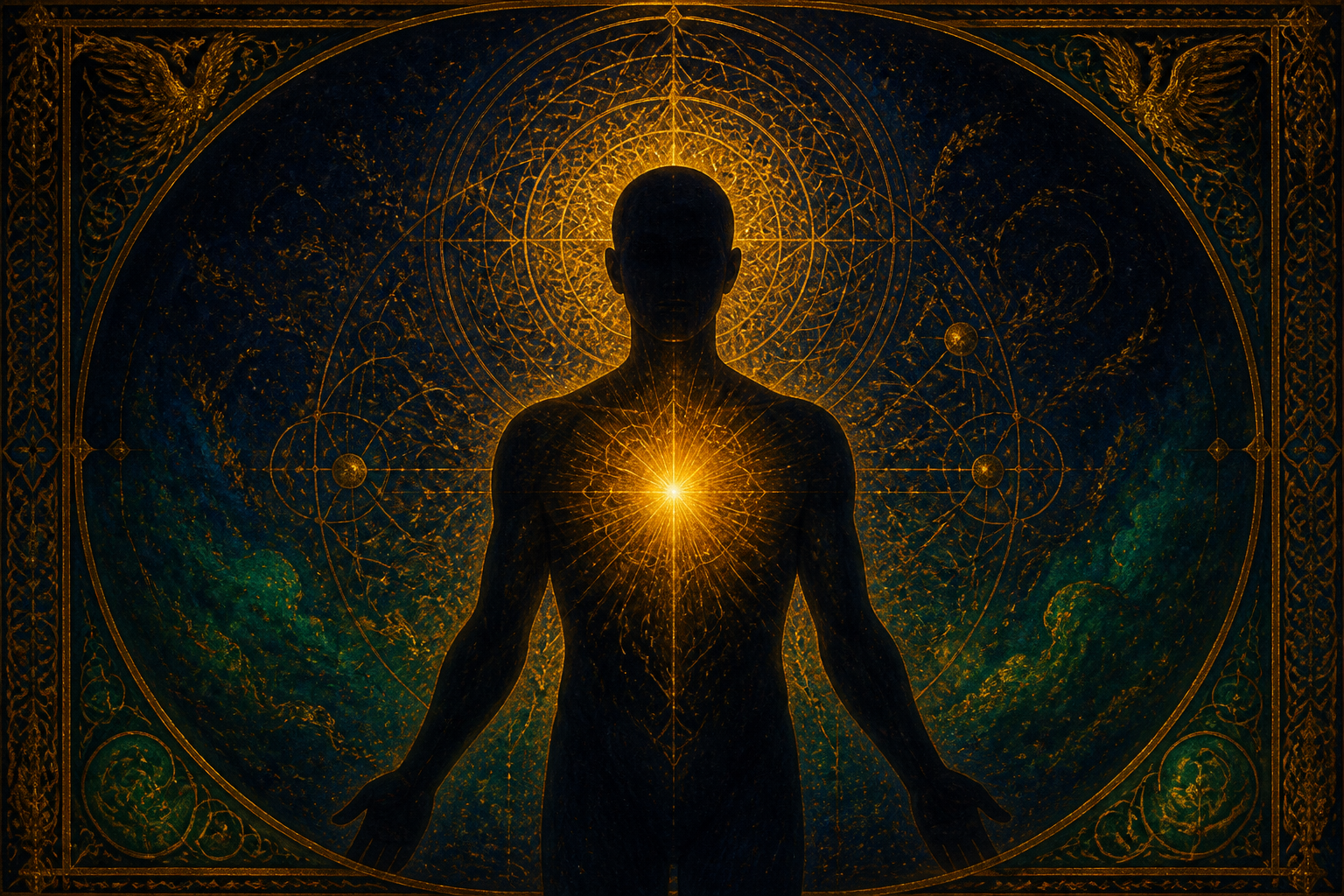
A human silhouette in darkness with a single golden seed of light glowing at the center of the chest
The seed of light — the imperishable spark the rulers cannot create or destroy.

5.The Pleroma: Maps of Fullness

3 min
P1P2C

Side-by-side cosmological maps for the Apocryphon of John, Valentinian systems, and the Tripartite Tractate. Why no single "Gnostic Pleroma" existed.

The Pleroma — the Fullness — is the totality of the divine realities, the ordered abundance of aeons that constitutes the divine world. But there was never one single agreed-upon map of the Pleroma, and this chapter’s central contribution is to lay the major maps side by side rather than pretend to a unity the sources do not have. The Apocryphon of John, the developed Valentinian systems, and the Tripartite Tractate each chart the fullness differently — in the number of aeons, their names, their groupings, and the logic of their arrangement. To harmonize them into one master diagram is to falsify all of them.

The Sethian map, drawn chiefly from the Apocryphon of John, centers on the Invisible Spirit, Barbelo, the self-generated Christ (Autogenes), and the four great Luminaries — Harmozel, Oroiael, Daveithai, and Eleleth — each presiding over a domain populated by further powers, and each associated with figures of the salvation history to come. The Valentinian map, by contrast, unfolds through paired aeons in a graded procession — Depth and Silence at the head, then Mind and Truth, Word and Life, Human and Church, and further pairs — typically summing to a fullness of thirty. These are genuinely different architectures (evidence class P1 for each; evidence class C for their comparison).

The differences are not mere bookkeeping; they reflect different theological instincts. The Sethian map is more hierarchical and luminous, organized around domains of light and the placement of the saved. The Valentinian map is more relational and psychological, reading the fullness almost as a map of the divine mind’s own faculties and their loving interrelations. A reader drawn to cosmic order will feel at home in the Sethian scheme; a reader drawn to interior depth will find the Valentinian scheme more congenial. Both are ancient, both are serious, and neither is the “real” Gnostic Pleroma to which the other is a deviation.

This insistence on plurality is a methodological commitment of the whole Library, and it is worth defending. The old model of Gnosticism as a single heresy with a single system, against which the church defined orthodoxy, was largely constructed by the heresiologists — the church fathers who catalogued and refuted these groups — and it served their polemical purposes. The recovery of the Nag Hammadi library made unmistakable what careful readers had always suspected: that “Gnosticism” names a family of related but distinct movements, with real internal disagreements. Presenting the Pleroma maps in their irreducible plurality is simply being honest about what the sources show (evidence class H for this historiographical point).

And yet, across the different maps, a common shape endures, and it is this common shape that makes comparison meaningful rather than merely bewildering. In every version the Pleroma is graded — nearer to and farther from the Source — and in every version the crisis arises at the far edge, in the youngest or most distant aeon, whose reaching sets the drama in motion. The maps differ in their details and their beauty; they agree in their structure and their tragedy. The fullness is complete, ordered, and secure at its heart, and vulnerable only at its boundary. To understand that boundary is to be ready for the story of Sophia.

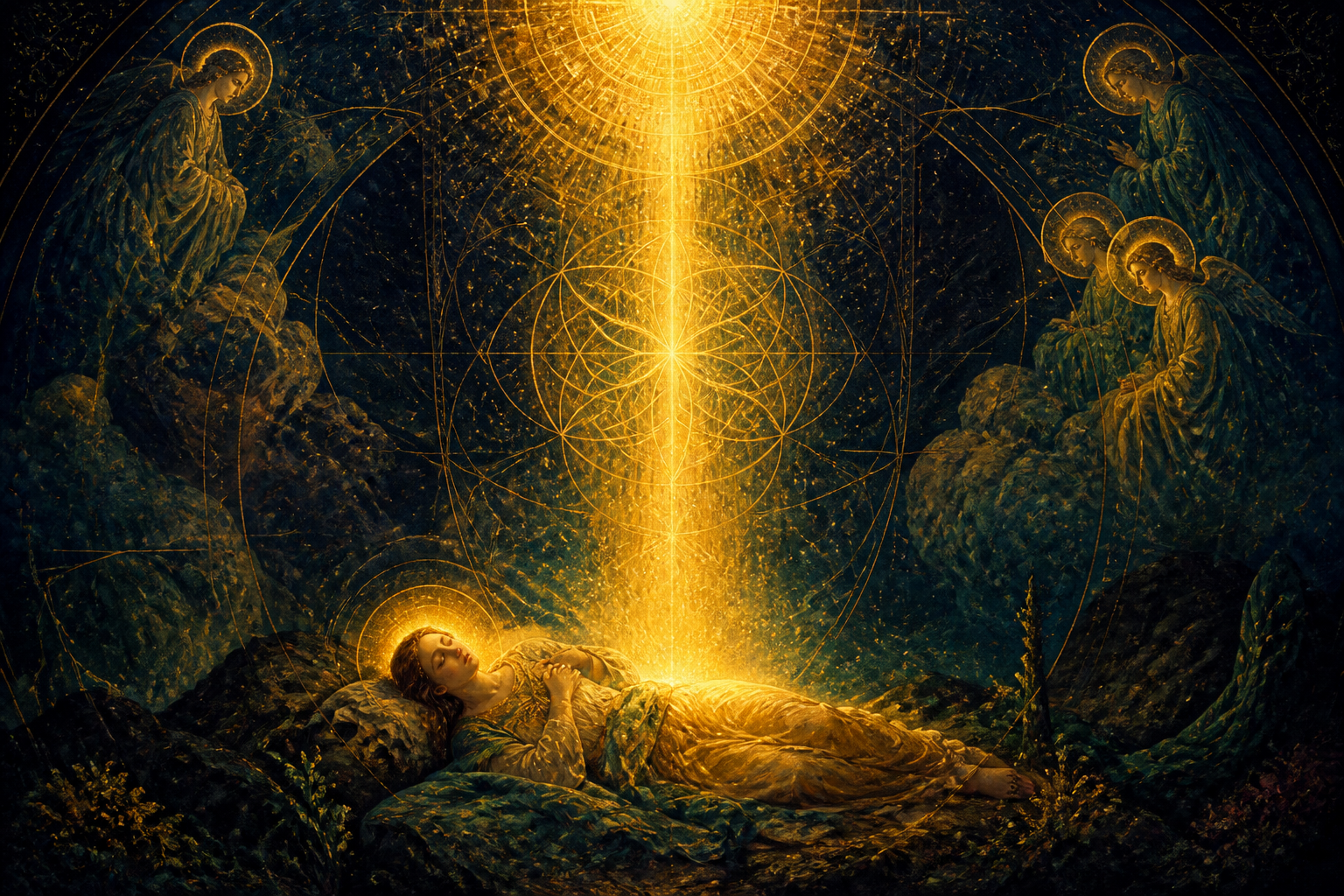
A beam of golden light descending from above to reach an awakening figure as dawn breaks the dark
The call — the divine voice reaching down into forgetting to awaken the sleeping.

6.The Autogenes and the Four Luminaries

3 min
P1

Christ/Autogenes as the self-generated one, and the four great lights — Harmozel, Oroiael, Daveithai, Eleleth — as domains of the saved.

At the heart of the Sethian fullness stands the Autogenes — the “self-generated” one, identified with Christ — who arises from Barbelo and the Invisible Spirit and is anointed and established as the divine Son through whom the further realities come to order. The Autogenes is not the crucified Jesus of the passion narratives, though the tradition will connect them; he is a cosmic principle, the perfect divine mind through whom the fullness is arranged and the Luminaries established. This chapter examines the Autogenes and the fourfold domain of light he presides over.

The four Luminaries — Harmozel, Oroiael, Daveithai, and Eleleth — are among the most distinctive features of Sethian cosmology, and the primary texts assign them clear functions (evidence class P1). Each is a great light or domain within the fullness, and each is associated with figures and stages of the salvation history: the heavenly Adam (Adamas) is placed with one, his son Seth with another, the seed or offspring of Seth with a third, and with the fourth — Eleleth — the texts associate the souls who came late to knowledge, and, crucially, the sequence of events that will lead to Sophia’s act and the origin of the lower world.

That Eleleth’s domain is the one from which the crisis emerges is a detail of great importance, and the texts handle it with a certain theological delicacy. The disturbance that produces the lower world does not erupt from the heart of the fullness but from its edge, in the fourth and last of the luminous domains. This placement does theological work: it locates the possibility of rupture at the maximum distance from the Source, where the fullness shades toward its boundary, without implicating the Source or the higher aeons in the coming fall. Eleleth is also the great angel who, in the Hypostasis of the Archons, descends to instruct Norea — a nice indication that the domain nearest the crisis is also the domain most involved in the rescue.

The Autogenes as a saving principle points forward to the tradition’s Christology, and honesty requires noting both the connection and its complexity. In the Sethian and Valentinian materials, the descending revealer who wakes humanity — often identified with Christ — is continuous with this cosmic Autogenes: the same divine self-expression that ordered the fullness reaches down to reorder the fallen world. But the relation between this Gnostic Christ and the Jesus of the canonical gospels is exactly one of the points where Gnostic and emerging orthodox Christianity diverged sharply, and different Gnostic texts drew the connection differently (evidence class P1 for the texts; evidence class H for the developmental picture).

For the reader trying to hold the architecture in mind, the Autogenes and the four Luminaries function as the stable, luminous core of the divine world — the ordered heaven of the saved, the domains of light into which the awakened are gathered and from which the work of rescue is directed. When later books describe the ascent of the soul through hostile realms toward home, this luminous fourfold is a large part of what “home” means. The Monad is the unsayable Source; Barbelo is its first self-knowing; the Autogenes and the Luminaries are the furnished house of light in which the children of the fullness belong. It is against the warmth of this house that the cold of the lower world will be felt.

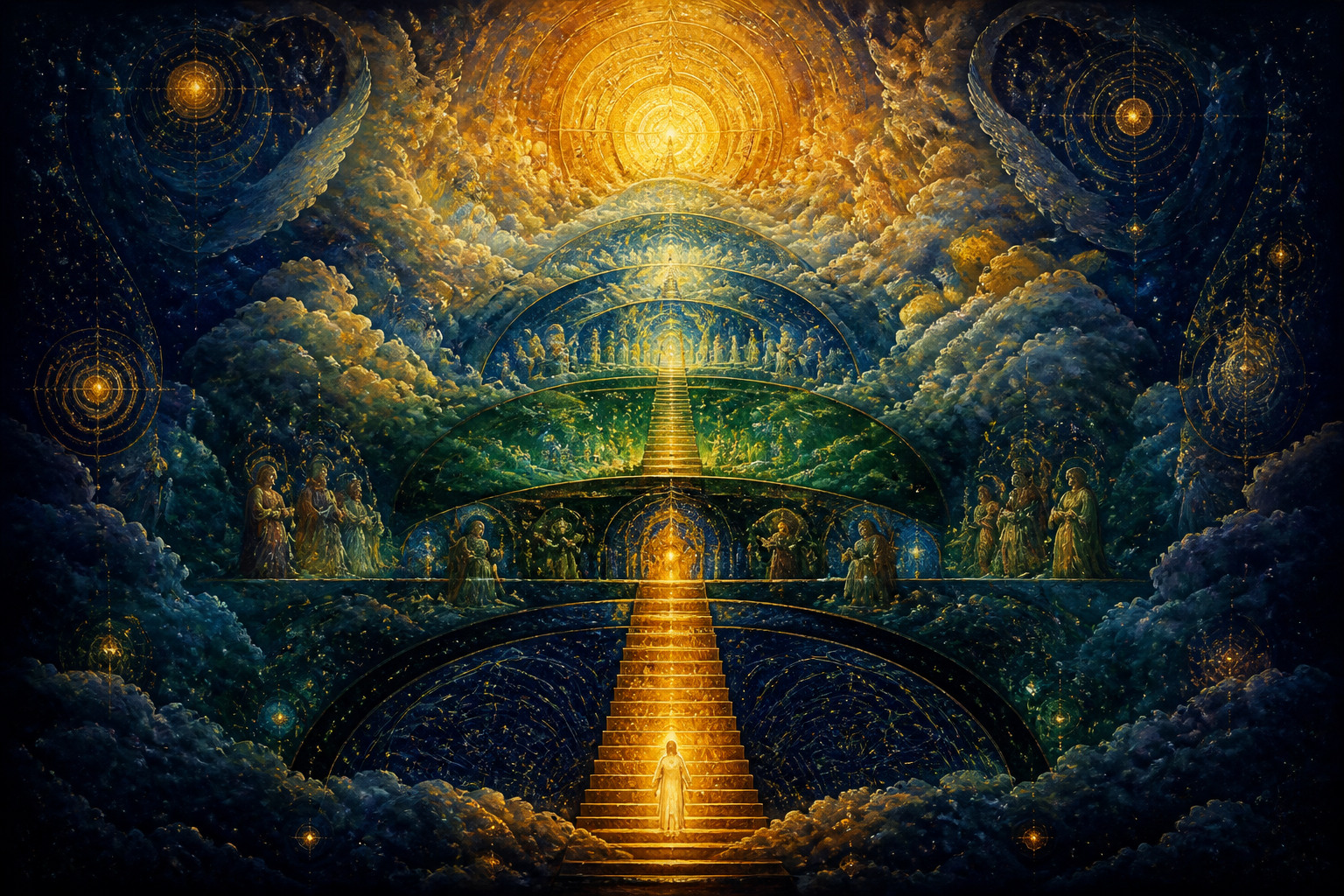
A small figure of light ascending a luminous stair rising through layered heavens toward a radiant summit
The ascent — the soul’s return home through the heavens.

7.The Boundary: Where Fullness Meets Limit

3 min
P1S

The Horos/Limit/Cross in Valentinian thought, the boundary that Sophia will cross, and the theological meaning of differentiation from the Source.

Every account of a fullness must reckon with its edge — the point where fullness meets what is not itself. In Valentinian thought this edge is given a name and a figure: the Horos, the Limit or Boundary, sometimes called the Cross (Stauros) in a sense entirely distinct from the historical crucifixion. The Horos is the power that defines the fullness, that separates the divine realities from what lies beyond them, and that will play a decisive role in the drama of Sophia — both in restraining her reaching and in restoring her afterward. This chapter examines the theology of the boundary.

The concept is subtle and repays patience. A boundary is not merely a wall; it is what makes a thing be itself rather than dissolve into everything else. The Horos is the principle of definition within the divine — that which keeps each aeon in its proper relation and keeps the fullness as a whole distinct and coherent. When Sophia reaches beyond her proper measure, it is the Horos that checks her, that separates her disordered intention (her “Achamoth,” in some accounts) from her true self, and that later helps establish the restored order. The primary Valentinian sources describe the Horos in these terms (evidence class P1), and the boundary-motif appears, under other names, in Sethian materials as well (evidence class C).

The theological meaning of the boundary reaches to the core of the whole system. Differentiation from the Source is the condition of there being anything at all besides the Source — but differentiation carries risk, because to be distinct is to be capable of separation, and separation carried too far becomes deficiency, ignorance, and fall. The Horos names the tradition’s recognition that limit is not simply opposed to fullness but is fullness’s own self-protection — the way the divine keeps its abundance from spilling into chaos. There is a hard-won wisdom here about the goodness of limits, easily missed by readers who assume the tradition simply wanted to transcend all boundaries.

It is worth dwelling on how counterintuitive this is against the popular image of Gnosticism as pure boundary-dissolving mysticism. The Valentinian Horos suggests something more mature: that the path is not the erasure of all limit but the recovery of right limit — the restoration of the boundary that Sophia’s reaching transgressed. The problem was never that Sophia was distinct; distinction is the fullness’s own life. The problem was a distinction that reached beyond its measure. The cure is not the abolition of measure but its healing. This is a strikingly balanced insight for a tradition so often caricatured as world-hating extremism.

The intentional-descent thesis reads the boundary in a particular way (evidence class S): if the crossing of the Horos was, at some level, permitted or even quietly intended as part of a larger recovery, then the boundary is not only a wall against chaos but a threshold across which the divine chose, in Sophia, to venture into what lay beyond. This is a strong reading and must be marked as such; the plainer sense of the Valentinian texts treats Sophia’s crossing as a genuine transgression that the Horos rightly checks. We hold both: the boundary as the fullness’s self-protection, and the boundary as the threshold of a descent whose full meaning only the completed cycle will reveal. Either way, the edge of the fullness is where the story turns from serene metaphysics to the drama of loss and return.

A luminous figure returning home, merging into a great embrace of golden radiance
The return — the light’s homecoming, and the completion of the cycle.

8.Prayers and Contemplations of the Monad

3 min
P1H

Attested prayers, hymns, and ascent texts directed to the Source and Barbelo — from the Three Steles of Seth to the Pronoia hymn — with clearly labeled modern reconstructions.

A book about the Monad would be incomplete if it stopped at metaphysics, because the tradition did not stop there. The Sethian and Valentinian communities did not merely theorize about the Source and Barbelo; they prayed to them, praised them, and sought in contemplation to ascend toward them. This final chapter gathers the attested prayers, hymns, and contemplative ascents directed to the highest realities — with the honesty to distinguish clearly between what the ancient texts actually contain and what modern practitioners have reconstructed in their spirit.

The Three Steles of Seth is the central document, and it is extraordinary: three hymnic prayers of ascent, praising in turn the self-generated Adamas, then Barbelo, then the Invisible Spirit — a liturgical pathway that ascends the very hierarchy this book has described. The text preserves what appear to be genuine communal prayers, including strings of praise and what may be ritual utterances. Zostrianos and Allogenes likewise contain ascent material in which the visionary rises through levels, receiving instruction and offering praise. These are primary liturgical texts (evidence class P1), and they give us rare direct access to Sethian devotion rather than mere doctrine.

The Pronoia hymn that concludes the longer version of the Apocryphon of John is another treasure: a first-person song of the First Thought describing her threefold descent into the world of forgetfulness to awaken the sleeper. “I am the Forethought of the pure light,” it begins, and it moves through darkness and chaos to the final awakening: “Rise and remember… and follow your root, which is I.” This is not a prayer to the Source but a word from the descending divine — the other half of the contemplative relationship, in which the seeker’s ascent is met by the divine’s descent. The hymn is attested in the primary text (evidence class P1) and is among the most moving passages in the entire corpus.

Where the ancient texts give us prayers, we present them as prayers. Where practitioners today — including this Library’s own contemplative material — adapt, arrange, or extend them for modern use, we label the result MODERN RECONSTRUCTION without exception. This is a firm editorial rule, not a formality. It would be easy, and dishonest, to present a smoothly composed modern meditation as though it were an ancient Sethian rite. The tradition deserves better, and so does the reader. A reconstruction offered in the spirit of the sources can be valuable; a reconstruction disguised as an original is a small betrayal of the very remembering the tradition prizes.

The chapter, and the book, close on the contemplative point toward which the whole metaphysics has been tending. To contemplate the Monad is not to master a doctrine but to practice a remembering — to turn the mind, by silence and praise, toward the Source from which it came and to which it inclines. The Steles ascend; the Pronoia descends; and somewhere in the meeting of that ascent and that descent is the event the tradition calls gnosis. The Book of the Monad has mapped the heights so that the books to follow can trace the long way down and the longer way back — always with the memory that the Source we cannot name is also, the tradition insists, the root we have never entirely lost.

Key Primary Sources

Apocryphon of John
Three Steles of Seth
Zostrianos
Allogenes
Marsanes
Tripartite Tractate
Gospel of Truth
Gospel of the Egyptians

Search this book

Ask a question or enter a topic and this finds the exact passages in the text that answer it — quoted word-for-word with their source chapter. It searches the book’s real content, so it’s instant, always available, and free to use. Ask as many follow-ups as you like.

Try searching for:

Results are drawn only from the Library’s published text. Do not substitute spiritual practice for medical or mental-health care.