
The Hidden Genesis

Gnostic Creation, Genesis 1–11, and the Reversal of the Fall Narrative

What if the story you were told about the beginning was only half the story?

Book 1 of 7

A detailed commentary on Genesis 1–11 that places the canonical narrative alongside its Gnostic reinterpretations. For every unit of text, the book provides the canonical summary, Hebrew and Septuagint context, Jewish interpretive tradition, early Christian readings, and the Sethian, Valentinian, and Ophite transformations — showing how what appears as a "fall" may conceal a deliberate act of divine seeding.

A single radiant point of golden light in dark cosmic space, sacred-geometry rings emanating outward
The Monad — the unknowable Source, the one light from which all fullness flows.

1.Two Beginnings: The Dual Creation Sequences

3 min
P1H

How ancient interpreters handled the differences between Genesis 1 and Genesis 2, and why Gnostic readers saw two distinct creators at work.

Anyone who reads the opening of Genesis slowly notices something the tradition has always known and rarely advertised: there are two creation accounts, and they do not fit together as smoothly as a single seamless story. In the first (Genesis 1:1–2:3) a transcendent God speaks the cosmos into ordered being over six days and calls it good, creating humankind — male and female together — in the divine image. In the second (Genesis 2:4–25) a more anthropomorphic LORD God forms a single man from the dust of the ground, plants a garden, and only later fashions the woman. For most of Jewish and Christian history these were read as complementary: a wide-angle overture followed by a close-up. The differences were harmonized, and the harmonization became invisible.

Ancient readers, however, were not all content to harmonize. The Gnostic authors of the second and third centuries seized precisely on the seams. If there are two accounts, they asked, might there be two makers? Might the God who speaks light into being differ from the one who molds clay, walks in the garden in the cool of the day, and fears that the human has “become like one of us”? The Apocryphon of John, our fullest Sethian witness, answers yes — but not in the flat way later critics accused it of. The true Source remains utterly transcendent; it is a lower, derivative power, Yaldabaoth, who imagines himself the sole creator and stamps that claim onto the material world.

It is important to state clearly what is evidence and what is interpretation. The existence of two literary strata in Genesis is a matter of near-universal scholarly consensus, arrived at long before anyone consulted Gnostic texts; source critics call them the Priestly and Yahwistic materials (evidence class H). That the Gnostics read a second creator into these seams is a matter of primary-text record (evidence class P1) — the Apocryphon of John says so explicitly. Whether the biblical authors themselves intended two deities is not what the Gnostics claimed and not what this book claims; the Gnostic reading is a reinterpretation, a deliberate re-reading against the grain, not a recovery of the original sense.

Why would anyone read the text this way? Because the Gnostic writers were wrestling with a real theological problem: how can a good, perfect, transcendent Source be responsible for a world so evidently marked by suffering, ignorance, and death? Their answer distributed the labor. The highest God did not make this flawed world directly; a lower power did, working with material and motives it did not fully understand. This is not casual blasphemy. It is a serious — if contestable — attempt to protect the goodness of ultimate reality from the wreckage of ordinary experience.

This chapter therefore reads the dual creation sequences on three levels at once: what the Hebrew and Greek texts actually say, how the mainstream traditions harmonized them, and how the Gnostic schools transformed them. Keeping these levels distinct is the discipline of the whole book. We are not claiming the Gnostics were right and the tradition wrong, or the reverse. We are tracing how the same handful of verses became the seedbed for radically different visions of who made the world and why — and why the question still matters to anyone who has ever wondered whether existence is a gift, an accident, or something stranger than both.


A luminous veiled feminine presence emerging as the first reflection of light within darkness
Barbelo — the First Thought, the divine world’s first self-reflection.

2.Image and Likeness: The Heavenly Human

3 min
P1P2

The distinction between the divine Image (the heavenly Anthropos) and the fashioned Adam — a key to understanding why rulers cannot fully control what they made.

Genesis 1:26 contains a phrase that has generated two thousand years of commentary: “Let us make humankind in our image, according to our likeness.” Two words — image (Hebrew tselem, Greek eikōn) and likeness (demut, homoiōsis) — and one troubling plural: “let us.” Rabbinic tradition read the plural as God addressing the angels or the heavenly court. Christian tradition often read it as an intimation of the Trinity. The Gnostic readers heard something else entirely: a conversation among the rulers, the archons, who see a luminous image reflected on the waters below them and resolve to make a copy of it in order to trap the light it carries.

The distinction between the heavenly Image and the earthly Adam is the hinge of the Gnostic anthropology. In the Apocryphon of John, a perfect Human — the Anthropos, sometimes called Adamas or the Immortal Human — exists in the divine realm before any earthly man is molded. The rulers glimpse this heavenly form, become enamored of it, and attempt to reproduce it. But a copy is not the original. What they fashion from matter is a body; what makes it truly human is the divine spark that enters it by a route the rulers neither control nor comprehend. This is the great irony the Gnostic authors savored: the makers of the human being do not own the most important thing about their creation.

The primary texts are remarkably explicit here (evidence class P1), and they converge across several witnesses — the Apocryphon of John, On the Origin of the World, and the Hypostasis of the Archons all describe the rulers modeling a form after a higher pattern they cannot fully possess (evidence class P2). Where the texts differ is in the mechanism and the mood: some emphasize the rulers’ arrogance, some their envy, some their sheer incompetence. The Gnostic imagination was not monolithic, and this book resists the temptation to flatten these accounts into a single official version.

What follows theologically is a stunning inversion of ordinary self-understanding. If the deepest truth of the human being is not the body the rulers made but the image they were imitating, then the self a person takes for granted — the anxious, mortal, socially-scripted self — is precisely the copy, and the true self is the forgotten original. Salvation, in this framework, is not the acquisition of something new but the recognition of something older and higher than the fashioned form. This is why the Gnostic tradition speaks less of being saved than of remembering, and why this Library is called the Library of Remembering.

It should be said plainly that the intentional-descent reading this Library develops — that the light was seeded into the human form on purpose, as part of a larger plan of recovery — is a synthesis (evidence class S). The ancient texts describe the light’s entry into Adam in various ways, and not all of them frame it as a deliberate strategy; some read more like a rescue improvised after a rupture. We will hold both readings open, because honesty about the sources is more valuable than a tidy thesis. What the texts do agree on is the core claim of this chapter: the human being is a contested object, made by lower powers but carrying a light those powers can neither create nor keep.

A luminous map of concentric spheres and paired points of light — the fullness of the aeons
The Pleroma — the fullness of the divine aeons.

3.Breath, Animation, and the Transfer of Power

3 min
P1S

How Sophia’s luminous power enters the human form through the breath of the chief ruler — the pivotal moment when divine light becomes hidden within matter.

The most vivid moment in the Gnostic retelling of creation is the animation of Adam. In the Apocryphon of John, the fashioned body of the first human lies inert — molded, complete in form, but lifeless. The chief ruler, Yaldabaoth, has unknowingly gathered into himself the luminous power that his mother Sophia lost in her descent. On the advice of higher powers who deceive him for the sake of the light, he is persuaded to breathe into the human’s face. In that breath the divine power passes out of the ruler and into the human form. The moment the human stirs and stands, the rulers realize with horror that the creature they made is more luminous than they are.

This scene is a deliberate rewriting of Genesis 2:7, in which the LORD God breathes the breath of life into the man’s nostrils and he becomes a living being. In the canonical text the breath is God’s own gift, unambiguous and good. In the Gnostic version the breath is a transfer — a smuggling operation by which the divine light hidden in the ruler is relocated into humanity, beyond the ruler’s reach. The rulers become, in effect, the unwitting couriers of the very thing that will undo their dominion. The primary text states this transfer directly (evidence class P1), and the motif of the maker being tricked into surrendering the light recurs across the corpus (evidence class P2).

The theological point is precise and worth dwelling on. Power, in this cosmology, does not stay where it is put. Sophia’s light, once dispersed, moves — from the higher realm into her flawed offspring, from the ruler into the human, and ultimately, the tradition hopes, from the human back home. The material world is not a sealed prison so much as a leaky one. The light keeps escaping upward. This is one reason the Gnostic worldview, for all its talk of darkness and captivity, is finally a literature of hope: the decisive advantage belongs not to the jailers but to the light they cannot hold.

The intentional-descent thesis reads this episode as the pivot of a plan (evidence class S): the light was not merely lost and then luckily recovered, but placed into the human form so that it could mature in the very conditions the rulers created. On this reading the breath of animation is the seed being planted in the soil where it must grow. The contrary reading — that the transfer is a clever rescue of light that never should have fallen — is equally present in the texts and equally defensible. We flag the difference rather than resolve it, and we note that the Valentinian and Sethian schools lean in somewhat different directions on exactly this point.

For the reader who cares less about ancient debate than about meaning, this chapter offers a durable image: within the ordinary human being, made of dust and shaped by forces larger and more careless than itself, there is a light that came from somewhere higher and is on its way somewhere higher still. Whatever one makes of the cosmology, the anthropology is worth sitting with. It suggests that the sense many people have — that they are more than their circumstances made them, that something in them does not belong to the machinery — is not a delusion to be corrected but a memory to be trusted.

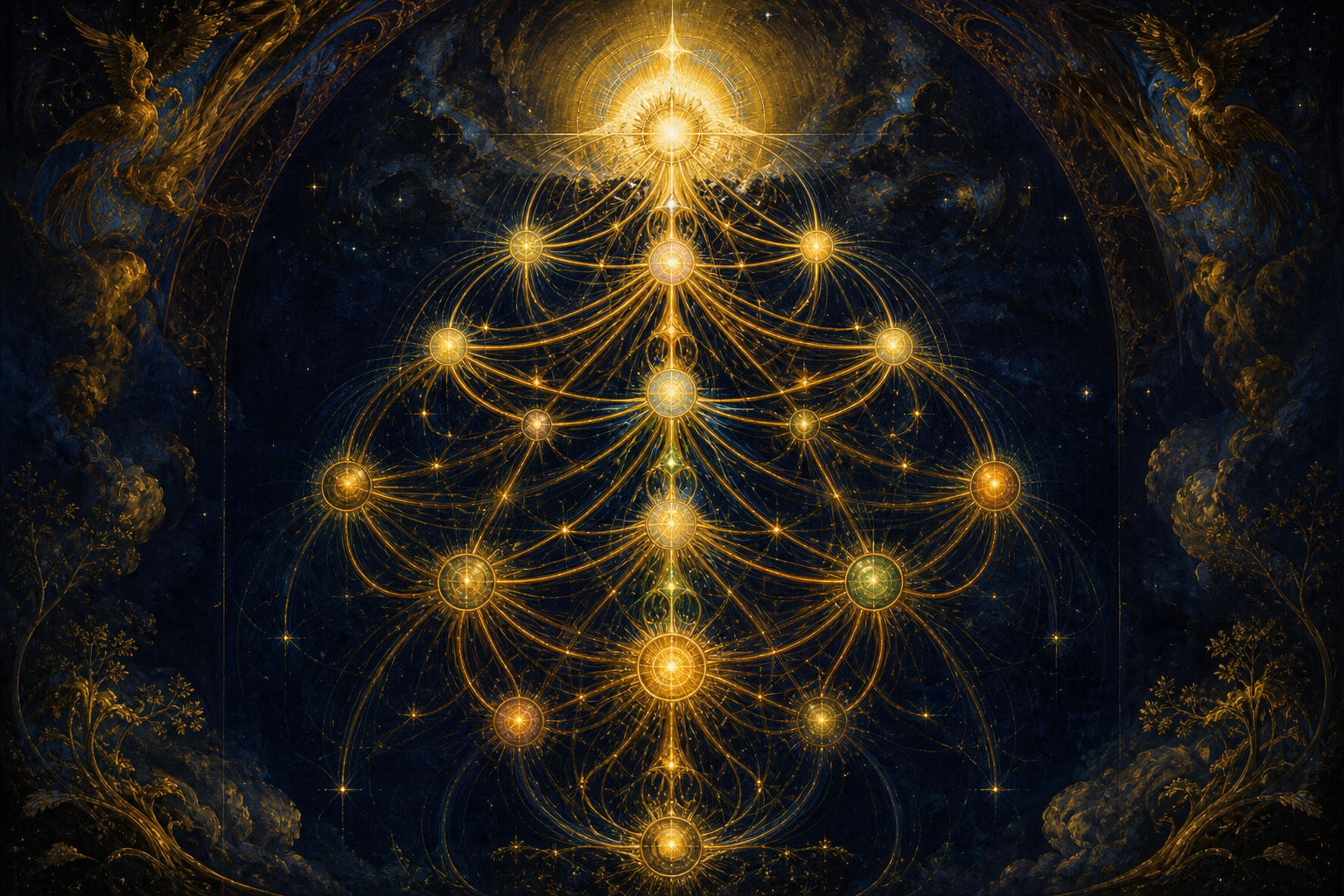
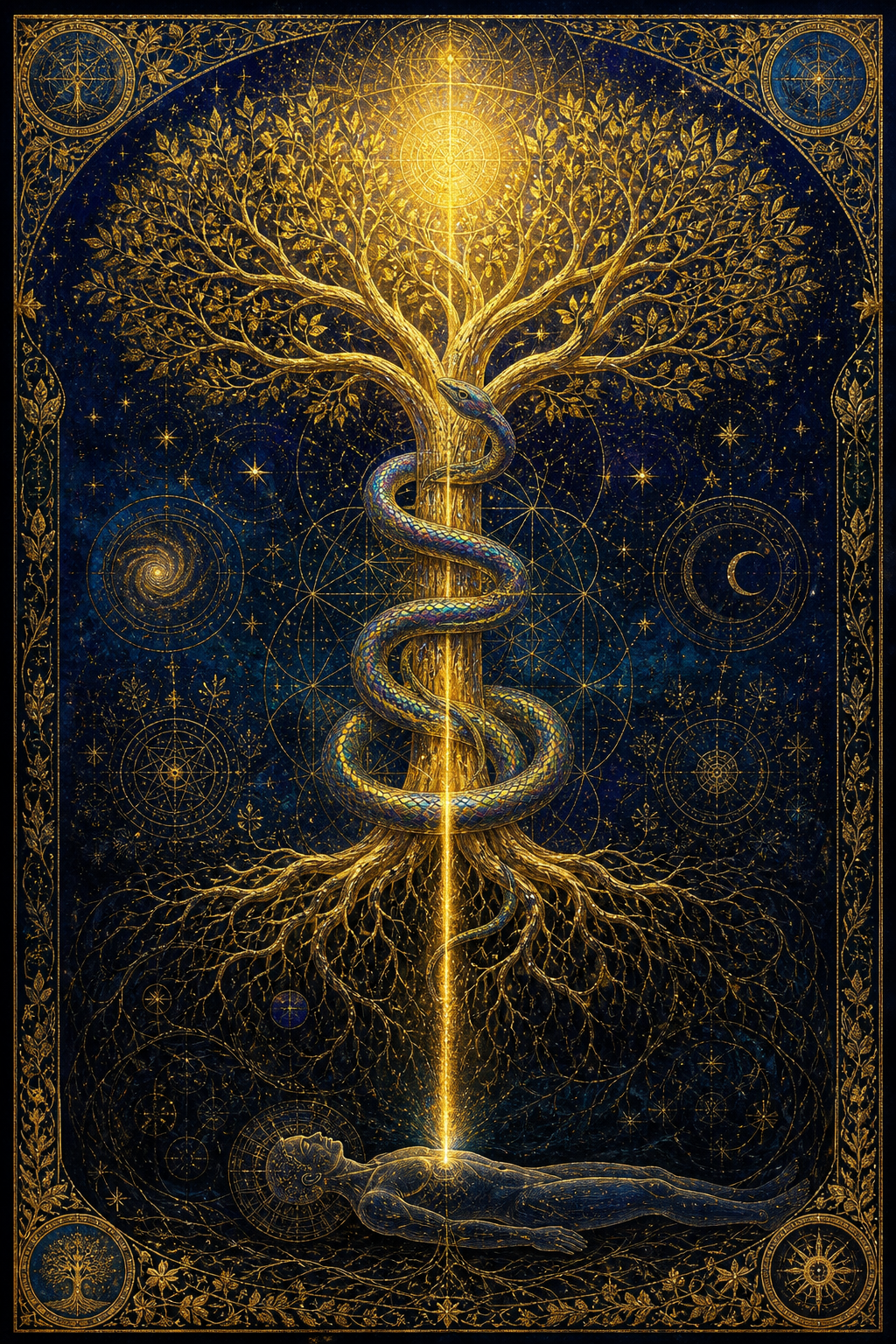
An abstract tree of light: branching gold lines connecting glowing nodes descending from a crown of light
The unfolding — emanation of the aeons from the Source (uncertainty in the outer branches).

4.Adam’s Sleep and the Appearance of Eve

3 min
P1C

The division of Adam, the emergence of Eve/Zoe/Epinoia as awakening intelligence, and the rulers’ failed attempts to recapture her.

The creation of Eve is, in the canonical Genesis, a scene of divine anesthesia and surgery: the LORD God causes a deep sleep to fall upon the man, takes a rib, and builds it into a woman. The Gnostic authors found in this “deep sleep” a symbol too rich to leave alone. For them the sleep of Adam is the sleep of forgetfulness that the rulers cast over humanity — the anesthesia not of a single surgery but of an entire condition. And the figure who emerges is not merely a companion but an awakening intelligence: Eve, called also Zoe (Life) and identified with Epinoia, the luminous afterthought sent to help the sleeping human remember.

In the Hypostasis of the Archons and On the Origin of the World, this feminine spiritual principle is repeatedly one step ahead of the rulers. When they seek to seize and defile her, she laughs, becomes a tree, or leaves a mere likeness of herself in their grasp while her true self escapes. The spiritual Eve cannot be captured because she is not, finally, of the same order as her would-be captors. The primary texts narrate these evasions directly (evidence class P1), and comparison across texts shows a stable pattern: the rulers pursue, the feminine light eludes, and the human is left with a helper the rulers meant to control but could not (evidence class C).

The relationship among Eve, Zoe, and Epinoia is one of the genuine puzzles of Gnostic studies, and this book does not pretend to a false clarity. Are they the same figure under different names, successive manifestations of one principle, or distinct characters that the texts sometimes conflate? Scholars disagree, and the texts themselves are not consistent (evidence class H, with real uncertainty). What can be said is that they cluster around a single function: the arrival, within the sleeping and forgetful human, of a spark of awakening — an intelligence that recognizes the human’s true origin and begins the slow work of waking it up.

This reframing of Eve is one of the most consequential in the Gnostic corpus, precisely because it reverses a long history of blame. In the reading that came to dominate later Christianity, Eve is the one through whom sin and death entered the world. In the Gnostic reading she is, at least in her spiritual aspect, the bearer of awakening — the one who moves the human toward knowledge rather than away from it. This does not make the Gnostic texts modern documents of gender equality; they are ancient and complicated, and their treatment of the feminine is layered with symbolism that resists easy political translation. But the contrast with the mainstream reading is real and instructive.

Underneath the mythology lies a psychological observation that has not aged. The human condition, these texts suggest, is one of sleep — a habitual, socially reinforced forgetting of who and what we are — and salvation begins not with effort but with waking. The figure of Epinoia is the name the tradition gave to that first stirring of recognition: the moment when a person, in the middle of an ordinary life, suddenly suspects that the story they have been told about themselves is not the whole story. Everything else in the Gnostic path follows from taking that stirring seriously instead of rolling over and going back to sleep.

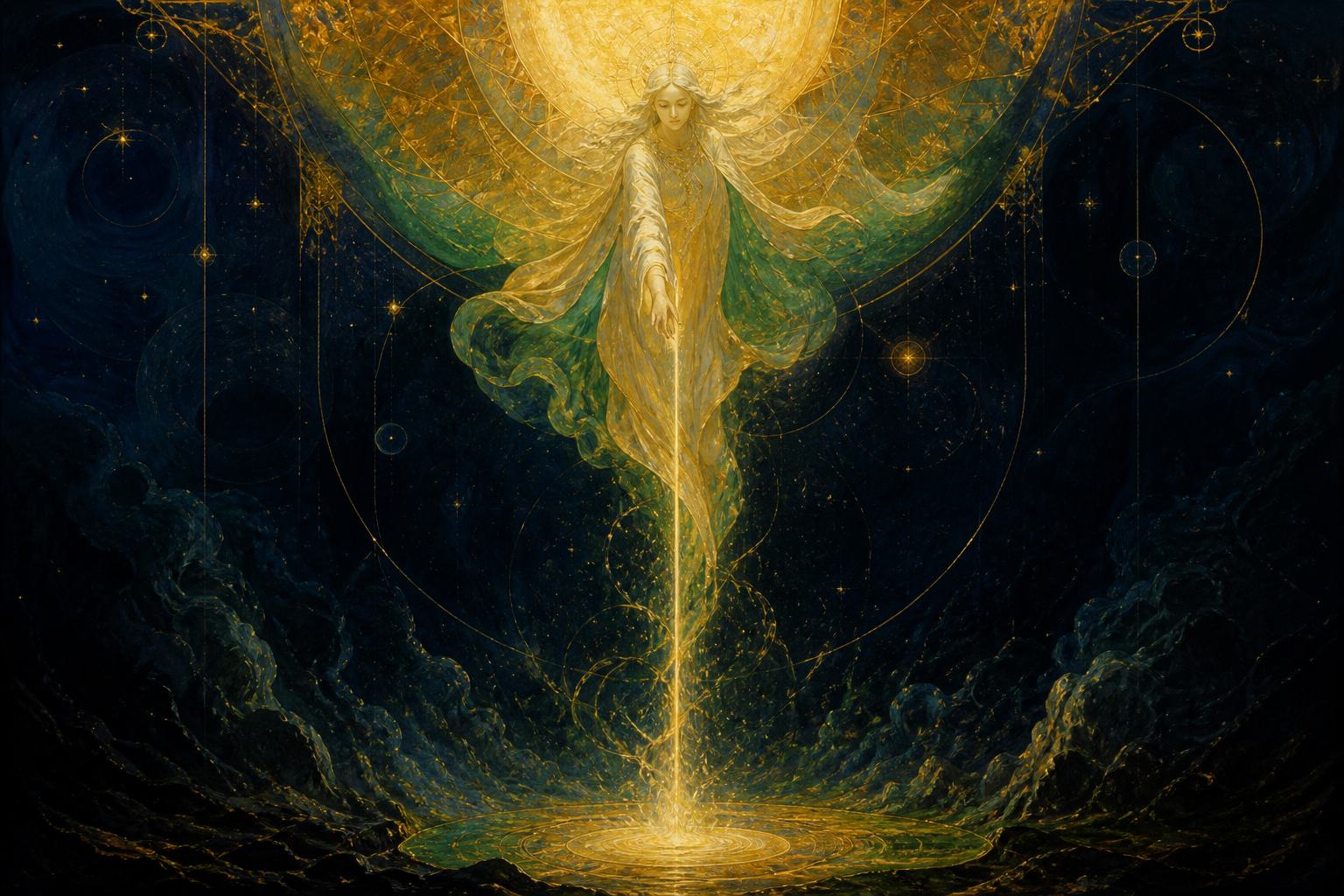
A robed feminine figure of light descending, a trailing ribbon of luminescence falling from the fullness into shadow
Sophia — Wisdom’s reaching and descent from the fullness.

5.The Serpent: Instructor, Deceiver, or Reversal?

3 min
P1P2C

Whether the serpent is a liberator teaching genuine knowledge, a tool of the rulers, or an ambiguous intermediary depends on which ancient school you ask — and the answer reshapes the entire narrative.

No figure in the Gnostic rereading of Genesis is more startling to the uninitiated than the serpent. In the canonical narrative the serpent is the tempter, the one whose counsel leads to the fall. In several Gnostic texts — most famously the Testimony of Truth and, in a more ambiguous key, the Hypostasis of the Archons — the serpent becomes an instructor, a bringer of the very knowledge the rulers wished to withhold. When the serpent tells the humans that eating from the tree will not kill them but will open their eyes, the Gnostic reading notes something the tradition prefers to skip: in the story as written, the serpent turns out to be telling the truth. Their eyes are indeed opened, and they do not die that day.

It would be a serious misreading, however, to conclude that the Gnostics simply worshipped the serpent or inverted good and evil for shock value. The texts are far more careful than their ancient critics alleged. In some accounts the instructing principle is distinguished from the mere animal serpent; the true instructor is a spiritual power that speaks through or alongside the serpent, while the serpent itself may be an ambiguous or even compromised intermediary. The Testimony of Truth, notably, is critical of naive serpent-veneration even as it affirms that knowledge, not obedience, is the path. The primary sources genuinely diverge here (evidence class P1 for the instruction motif; evidence class U for the serpent’s ultimate status), and this divergence is data, not noise.

What unites the Gnostic readings is the revaluation of the prohibition itself. Why would a good creator forbid the knowledge of good and evil? In the canonical text the prohibition is simply God’s command, and obedience is the issue. In the Gnostic text the prohibition is the rulers’ attempt to keep humanity ignorant — to prevent the awakening that knowledge would bring. On this reading the “transgression” is the first act of liberation, the moment the human reaches past the boundary the jailers drew. The serpent, whatever its ultimate nature, is the occasion of that reaching.

This chapter insists on holding the ambiguity rather than resolving it into a slogan. “The serpent was really the good guy” is too crude; so is the traditional “the serpent was simply the devil.” The Gnostic texts offer at least three positions — serpent as genuine liberator, serpent as tool of the rulers wearing a liberating disguise, and serpent as ambiguous intermediary through which a higher power speaks — and different communities held different views. A reader who wants the tradition’s real texture must be willing to live in that uncertainty for a while.

The enduring provocation of the chapter is the question it forces: is the knowledge that disturbs our innocence a curse or a gift? The mainstream tradition, reading the fall as catastrophe, tends toward the first answer. The Gnostic tradition, reading the opening of the eyes as awakening, tends toward the second. Most human lives contain evidence for both. The Gnostic wager is that the discomfort of knowing — of seeing the machinery, of losing the easy comforts of the unexamined life — is the necessary price of coming home, and that the beings who would rather keep us comfortable and asleep are not our friends.

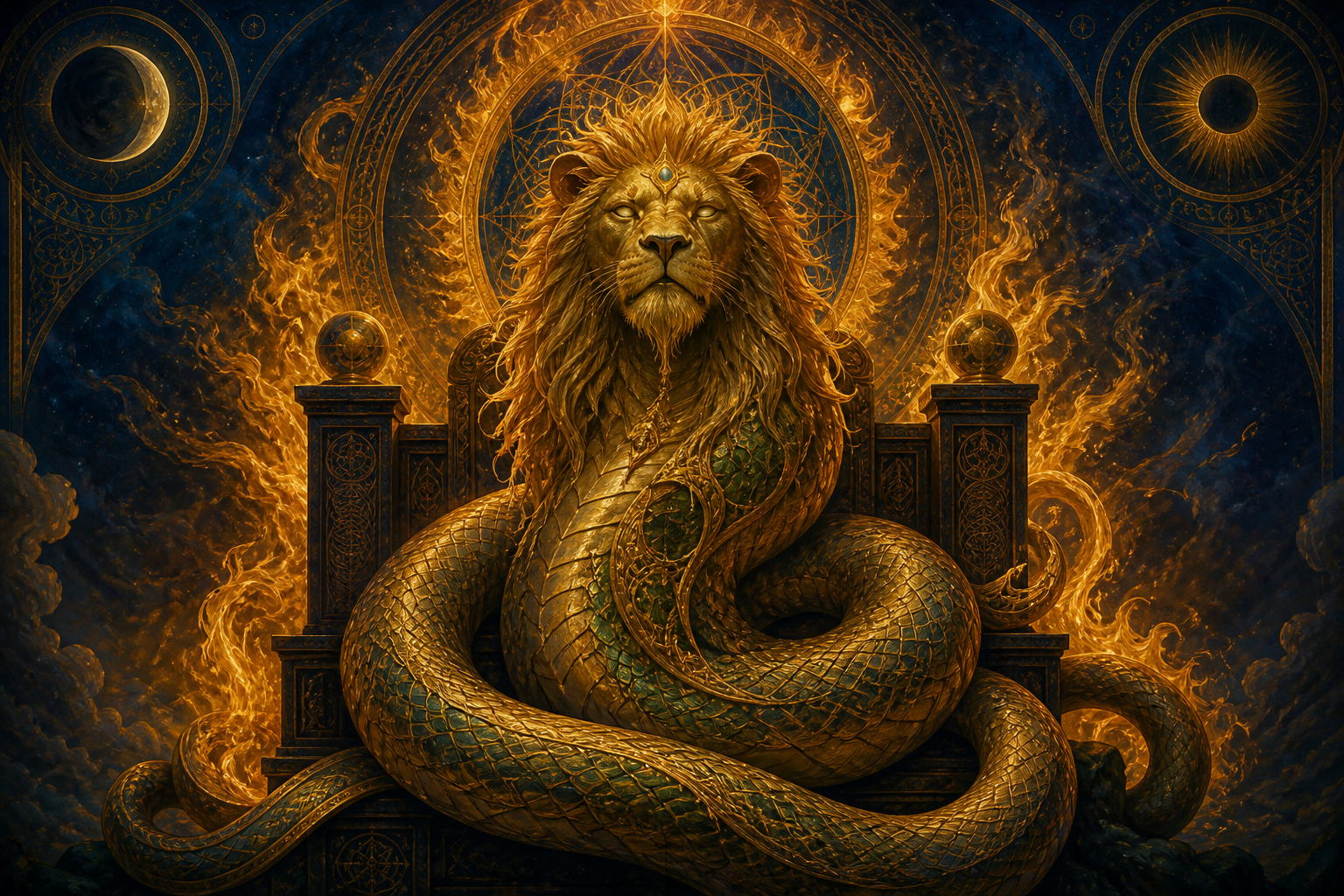
A lion-faced, serpent-formed demiurge wreathed in fire upon a dim throne
Yaldabaoth — the ignorant chief ruler who mistakes his borrowed power for the whole of reality.

6.Trees of Knowledge and Life

3 min
P1S

Prohibition, awakening, shame, garments of skin, and expulsion: the Gnostic reversal in which the rulers’ punishment becomes the path of liberation.

The two trees of the garden — the tree of the knowledge of good and evil and the tree of life — organize the Gnostic reading of the fall as thoroughly as they organize the canonical text, but the valuation is reversed and complicated. In the mainstream reading, eating from the tree of knowledge is the transgression that bars humanity from the tree of life. In the Gnostic reading, the tree of knowledge is bound up with awakening, and the rulers’ real fear is that the human will eat from the tree of life as well and become permanently beyond their control. The expulsion from the garden, so often read as punishment, is reread as the rulers’ defensive maneuver — an attempt to cut off access before the awakening becomes irreversible.

The “garments of skin” that God makes for the humans in Genesis 3:21 became, in Gnostic and later Platonizing Christian thought, a symbol of profound importance. The garments were read as the material body itself — the heavy, mortal covering placed over the luminous human after the awakening, to weigh it down and bind it to the rulers’ world. On this reading embodiment as we know it is not the original human condition but a secondary imposition, a prison uniform issued after the first act of remembering. The motif is attested across several texts and later commentators (evidence class P1 in the Gnostic sources; the wider “garments” tradition is H).

This is the point at which the Gnostic reading is most vulnerable to caricature, and where care is most needed. To say the body is a “garment of skin” imposed by lower powers is not necessarily to despise the body or to counsel neglect of it. The best of the tradition treats the body as a real condition to be understood and worked with, not a mere illusion to be scorned. But it is honest to acknowledge that some strands of Gnostic thought did tilt toward a genuine world-denial, and that this tilt drew sharp criticism from other early Christians who insisted on the goodness of creation. This Library presents the world-denying strand without endorsing its excesses.

The reversal of punishment into liberation is the signature move of the whole chapter, and it deserves to be stated with precision. The Gnostic authors did not deny that expulsion, toil, pain, and death entered human experience; they reinterpreted their cause and meaning. What the rulers intended as punishment and containment, the higher powers turned toward the maturing of the seed. The expelled human, cast into the harsh field of the world, is now in exactly the conditions where the light can grow toward self-recognition. This is the intentional-descent thesis applied to the fall (evidence class S): the exile is real, but it is also the school.

For the modern reader the trees offer a lasting parable about the cost of consciousness. To eat from the tree of knowledge is to lose the garden — to trade the peace of not-knowing for the burden and dignity of sight. Many spiritual traditions counsel a return to innocence; the Gnostic tradition, distinctively, counsels forward, through knowledge, toward a second and higher integration that is not innocence recovered but consciousness completed. The garden behind us is closed. The tree of life, the texts insist, is still ahead.

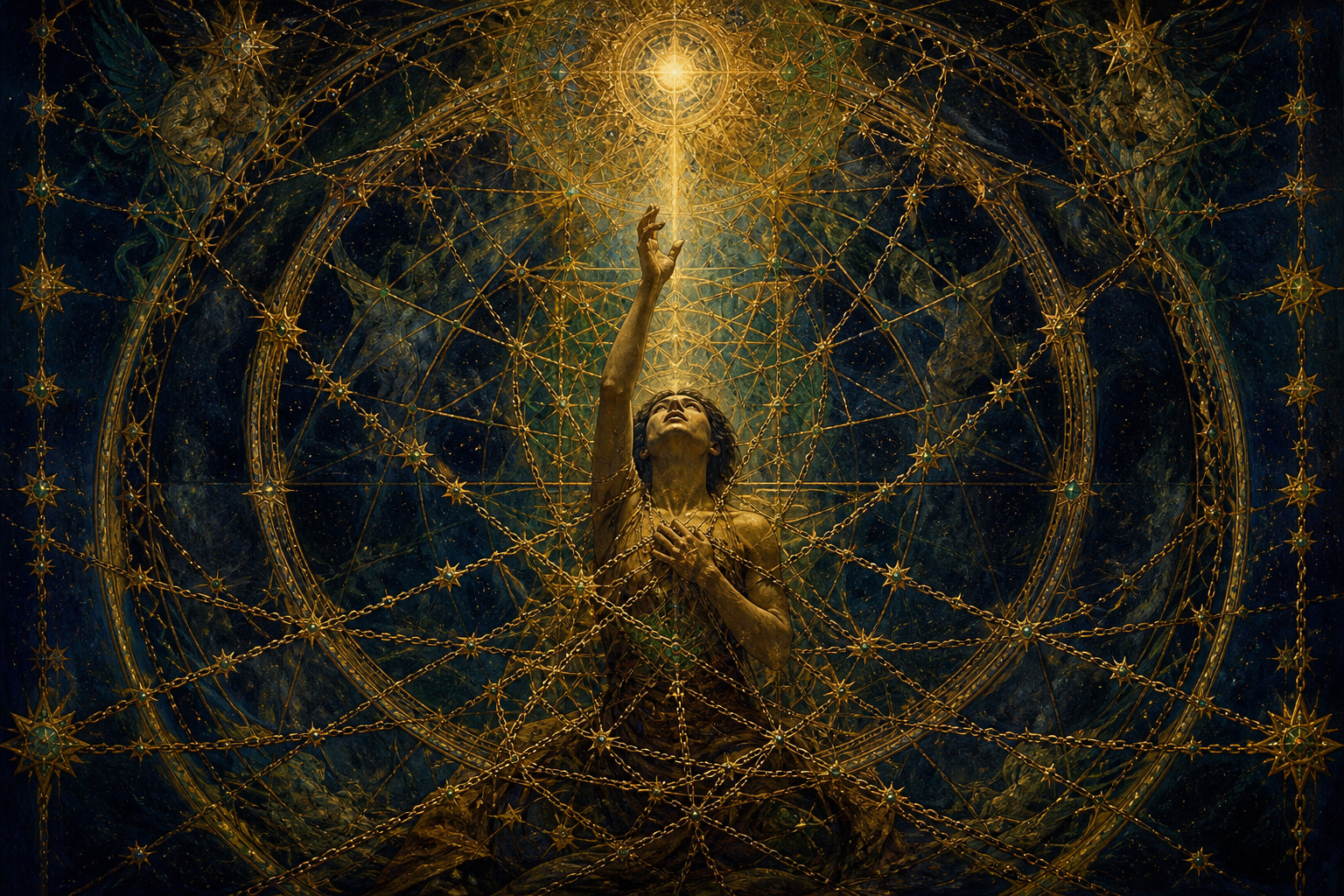
A solitary human figure enclosed within a lattice of geometric lines and chains of stars, yearning upward
The counterfeit cosmos — the soul bound by matter and fate.

7.Cain, Abel, Seth, and the Seed of Light

3 min
P1H

The Sethian lineage as carriers of the divine seed, Norea’s defiance, and the flood as the rulers’ attempt to destroy the awakened bloodline.

After the garden, Genesis turns to the generations of Adam, and the Gnostic authors followed — with a genealogy of their own. Where the canonical text traces the line of Cain and then the line of Seth, the Sethian Gnostics made Seth the carrier of the divine seed, the ancestor of a spiritual race in whom the light of the awakened Adam and Eve continued. Cain and Abel, in several readings, are associated with the rulers’ influence or with the mixed and violent inheritance of the material world, while Seth represents the pure line — not a biological master race, the careful reader must insist, but a symbol of the community of the awakened wherever they appear.

The figure of Norea, daughter of Adam and Eve and sister-wife of Seth in some texts, is one of the most striking in the Sethian corpus. In the Hypostasis of the Archons she confronts the rulers directly, refuses their authority, burns the ark that Noah built at their command, and cries out for help to the highest realm — whereupon the great angel Eleleth descends to instruct and defend her. Norea is defiance embodied: the awakened human who will not submit to the powers even when they hold every apparent advantage. The primary text is explicit and vivid (evidence class P1), and Norea recurs across the Sethian material as a stable figure (evidence class P2).

The flood, in this reading, takes on a chilling second meaning. In the canonical narrative the flood is God’s judgment on human wickedness, with Noah as the righteous remnant. In several Gnostic texts the flood is the rulers’ attempt to wipe out the awakened bloodline — to drown the seed of light before it can spread — and the true rescue of the spiritual race is accomplished not by the ark but by the higher powers, sometimes explicitly against the rulers’ intent. This is a bold and unsettling inversion (evidence class P1 for the texts that make it; H for the wider reconstruction of Sethian salvation history), and it shows how thoroughly the Gnostic imagination reread the entire primeval history, not merely the garden.

It is essential to name the danger in the language of “seed” and “race,” because that language has been abused in modern times in ways utterly foreign to the ancient texts. The Sethian “race of Seth” is not an ethnic or biological category; it is a spiritual one, defined by awakening and recognition, open in principle to anyone in whom the light stirs. To read it as a doctrine of hereditary superiority is to import a modern racial ideology the texts do not contain and would not recognize. This Library states that plainly and repudiates any such reading.

What the genealogy of light finally offers is a story of transmission — the idea that awakening, once it enters the world, is passed on, carried by a lineage not of blood but of recognition, and that the powers of forgetfulness have never succeeded in stamping it out. Every generation, the Sethians believed, contains its carriers of the seed. The image is quietly encouraging: whatever the pressures of the age, the light has always found someone to carry it forward, and the flood has never been total.

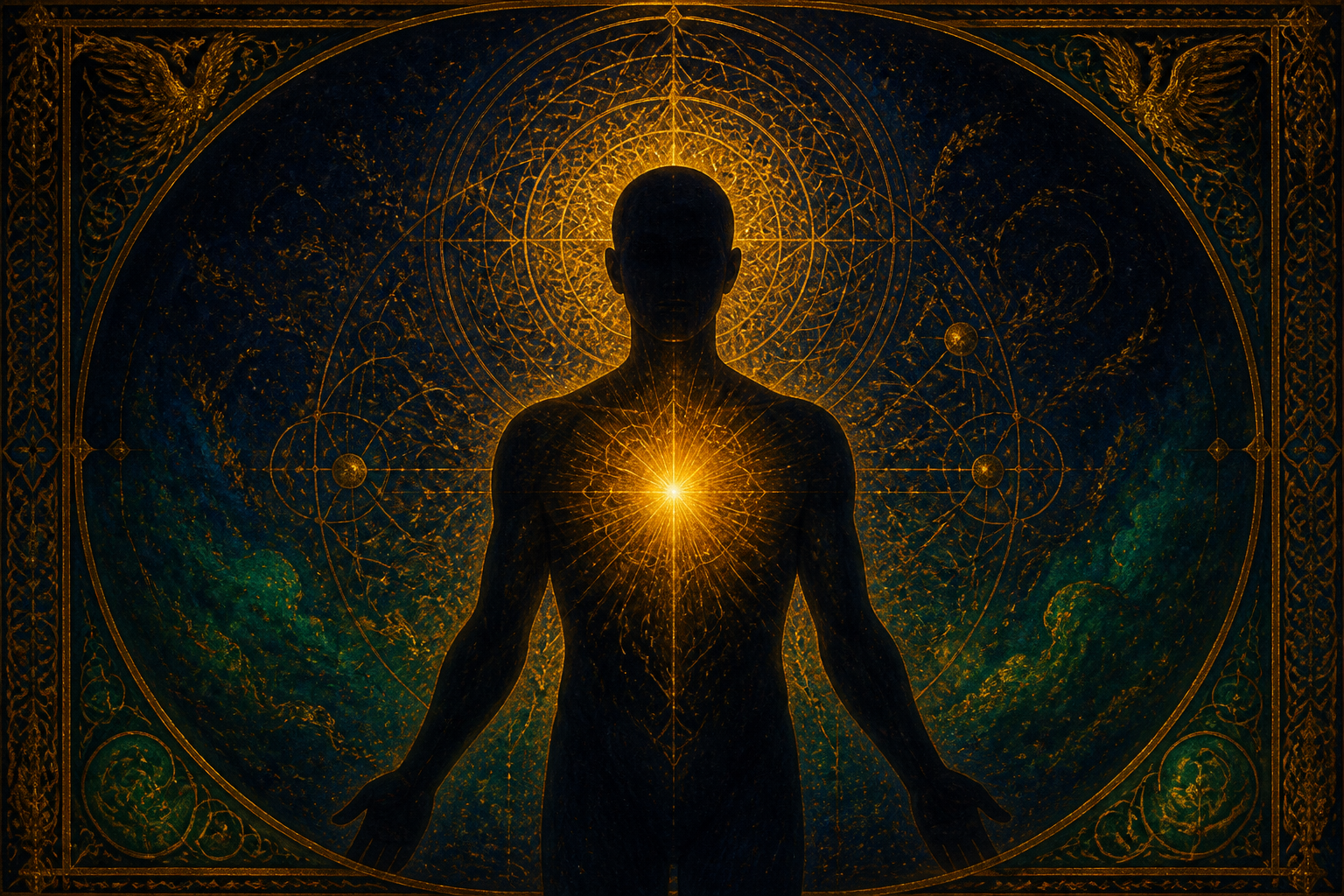
A human silhouette in darkness with a single golden seed of light glowing at the center of the chest
The seed of light — the imperishable spark the rulers cannot create or destroy.

8.Why the Rulers Fear Awakened Humanity

3 min
P2S

Counterfeit narratives, systems of forgetfulness, and the mechanisms by which archontic structures perpetuate control — and how each text describes their exposure and dissolution.

Why, the Gnostic texts keep asking, do the rulers fear awakened humanity so intensely? The answer they give is not that the rulers are strong and humanity weak, but nearly the reverse. The rulers depend on human forgetfulness. Their authority is real only so long as humans do not remember their origin, do not recognize the light within them, and do not see the machinery of control for what it is. An awakened human is, from the rulers’ point of view, a catastrophic security breach — a being who carries a higher power and who, upon remembering it, can no longer be governed by fear, shame, or the promise of belonging.

The texts describe a whole apparatus of forgetfulness. There is the “counterfeit spirit,” a false animating principle the rulers use to imitate the true spirit and keep humans attached to the passions and to the rulers’ world. There is fate (heimarmene), the binding of human life to the movements of the cosmic powers. There are the passions, the appetites and fears that keep attention fixed downward. And there are counterfeit narratives — stories about God, self, and world that are close enough to the truth to be believed but distorted enough to keep the sleeper asleep. These mechanisms are described across the corpus (evidence class P1), and the pattern of a manufactured forgetfulness is one of the most stable features of Gnostic thought (evidence class P2).

The intentional-descent thesis reads this apparatus not as an accident but as the resistance that awakening must overcome (evidence class S). If the light was seeded into the world to mature, then the world’s systems of forgetfulness are precisely the friction against which the seed grows strong. This is a demanding idea, and an honest presentation must note its risks: taken crudely, it can slide into a paranoia that sees hidden malevolence everywhere and enemies in every institution and person. The best of the tradition resists this. The archons are cosmic principles and internal conditions, not a license to accuse one’s neighbors.

This Library draws a firm ethical line here, and repeats it wherever the theme recurs. To say that the world contains systems of forgetfulness and domination is a spiritual and social observation with obvious modern analogues — the ways attention is captured, appetites manipulated, and identities scripted. It is not a claim that particular living people are literal archons, and any reading that ends in fear, accusation, or contempt for others has left the tradition’s better path. Awakening, in the texts’ own logic, dissolves fear; it does not manufacture it.

The chapter closes on the note the texts themselves strike: the rulers’ power, however elaborate, is finally hollow. It rests entirely on a forgetting that can be undone. The moment a human genuinely remembers — recognizes the light, sees the machinery, and ceases to be governed by the passions the rulers exploit — the whole structure of domination loses its grip on that person. The rulers cannot create light, cannot keep it, and cannot survive its recognition. Their fear is well founded. The awakened human is exactly what they cannot control, and every act of remembering is a quiet dismantling of a prison that was never as solid as it looked.

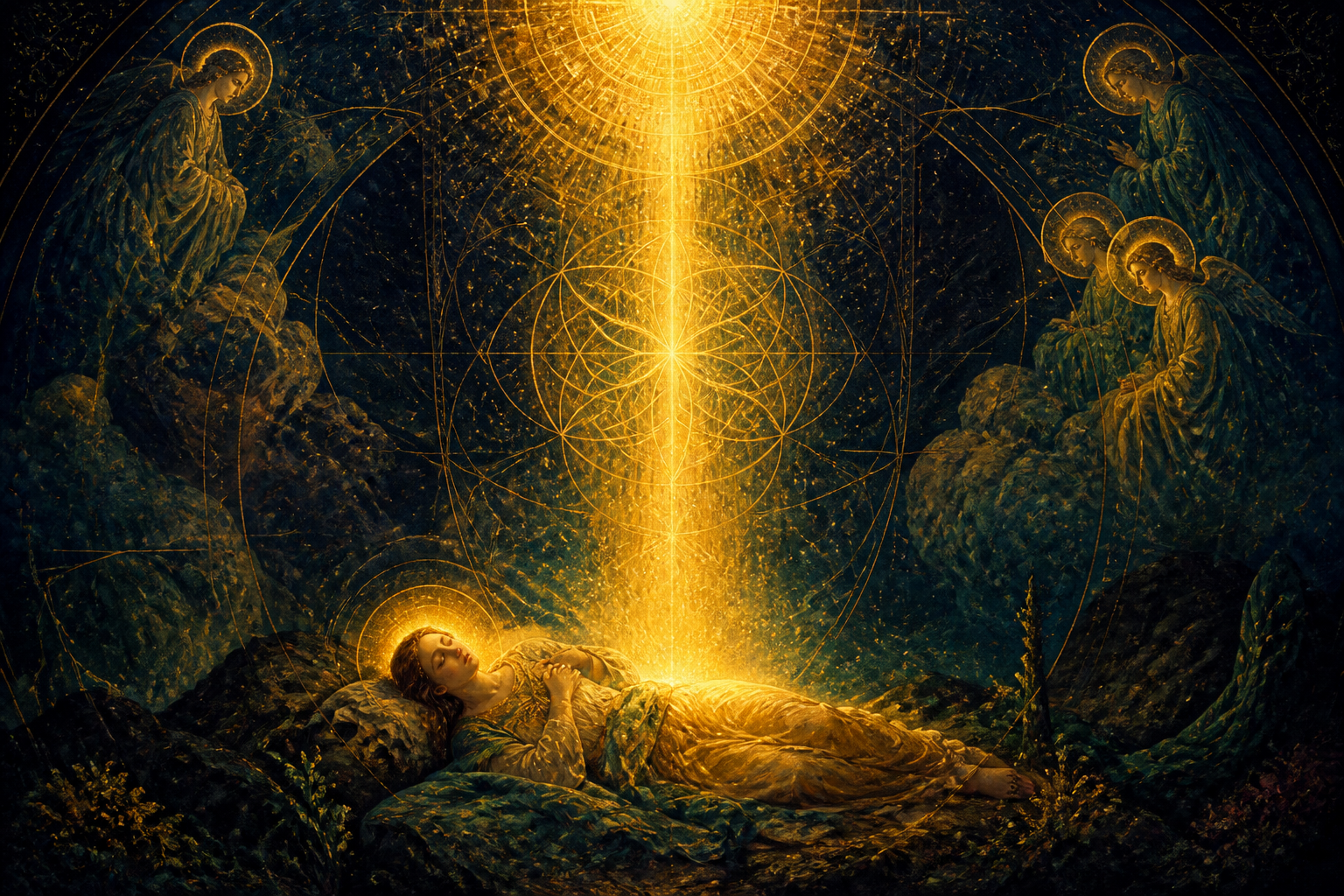
A beam of golden light descending from above to reach an awakening figure as dawn breaks the dark
The call — the divine voice reaching down into forgetting to awaken the sleeping.

9.Creation as Seedbed: Prison, Womb, or School?

3 min
CS

Nine competing metaphors for the material world, tested against the primary texts. The intentional-descent thesis proposes that creation is simultaneously a prison and a gestational environment.

Having traced the Gnostic rereading of Genesis chapter by chapter, this final chapter steps back to ask the question the whole book has been circling: what, finally, is the material world? The Gnostic texts do not give one answer; they give several, and the honest course is to lay them side by side rather than force a verdict. This chapter tests nine metaphors against the primary sources — the world as prison, as error, as accident, as trap, as exile, as illusion, as school, as womb, and as seedbed — and asks which the texts support, and how strongly.

The darker metaphors have real textual warrant. The world as prison and the body as garment of skin are attested (evidence class P1); so is the language of error and deficiency, especially in the Valentinian meditation on Error in the Gospel of Truth. A reader who wants the tradition to be uniformly life-affirming will have to reckon with these strands, which are neither marginal nor easily explained away. Some Gnostic communities did experience the world primarily as a place of captivity from which the spirit longs to escape, and their literature reflects that experience without apology.

But the constructive metaphors are also present, and they are what make the intentional-descent reading possible. The image of the seed hidden in the maker’s work, growing toward recognition; the language of the world as the place where the light matures; the insistence that the rulers’ containment is being turned to the light’s advantage — these support reading the world not only as prison but as gestational environment (evidence class S). On this reading prison and womb are not contradictory but sequential aspects of one condition: the same enclosure that confines is also the enclosure in which something grows until it is ready to be born.

This Library commits, as a matter of method, to presenting the intentional-descent synthesis as its own interpretive proposal and not as the plain sense of the ancient texts. The texts permit this reading; they do not compel it. Where the sources lean darker, we say so. Where the synthesis reaches beyond what any single text states, we mark it S and move on. The reader is not asked to accept a doctrine but to think alongside a tradition that took the strangeness of existence more seriously than most, and to decide for themselves how much of the reading persuades.

The book ends where the tradition ends: not in the world but beyond it, and yet not by contempt for the world but by passing through it. If creation is a seedbed, then the point was never to hate the soil but to grow through it toward the light. The Gnostic path, at its best, is not an escape from a hated cosmos but a maturation within a difficult one — a remembering, a strengthening, and finally a return that carries back home whatever the descent made possible. What that return looks like, and how the tradition mapped the journey home, is the work of the books that follow.

Key Primary Sources

Apocryphon of John (all recensions)
Genesis 1–11 (Hebrew & LXX)
Hypostasis of the Archons
On the Origin of the World
Gospel of Truth
Apocalypse of Adam
Testimony of Truth

Search this book

Ask a question or enter a topic and this finds the exact passages in the text that answer it — quoted word-for-word with their source chapter. It searches the book’s real content, so it’s instant, always available, and free to use. Ask as many follow-ups as you like.

Try searching for:

Results are drawn only from the Library’s published text. Do not substitute spiritual practice for medical or mental-health care.