The Atlas of the Pleroma

Cosmology Maps, Genealogies, Timelines, Ascent Maps, and Symbolic Diagrams

See the invisible architecture — from the Source through the aeons to the rulers and back.

Book 7 of 7

The visual reference companion for the entire Library. Side-by-side cosmology maps for the Apocryphon of John, Valentinian systems, On the Origin of the World, and Pistis Sophia. Aeon genealogies with uncertainty markers, archon charts with source-specific variants, multiple-descent timelines, Genesis reversal diagrams, human composition maps, and manuscript transmission timelines.

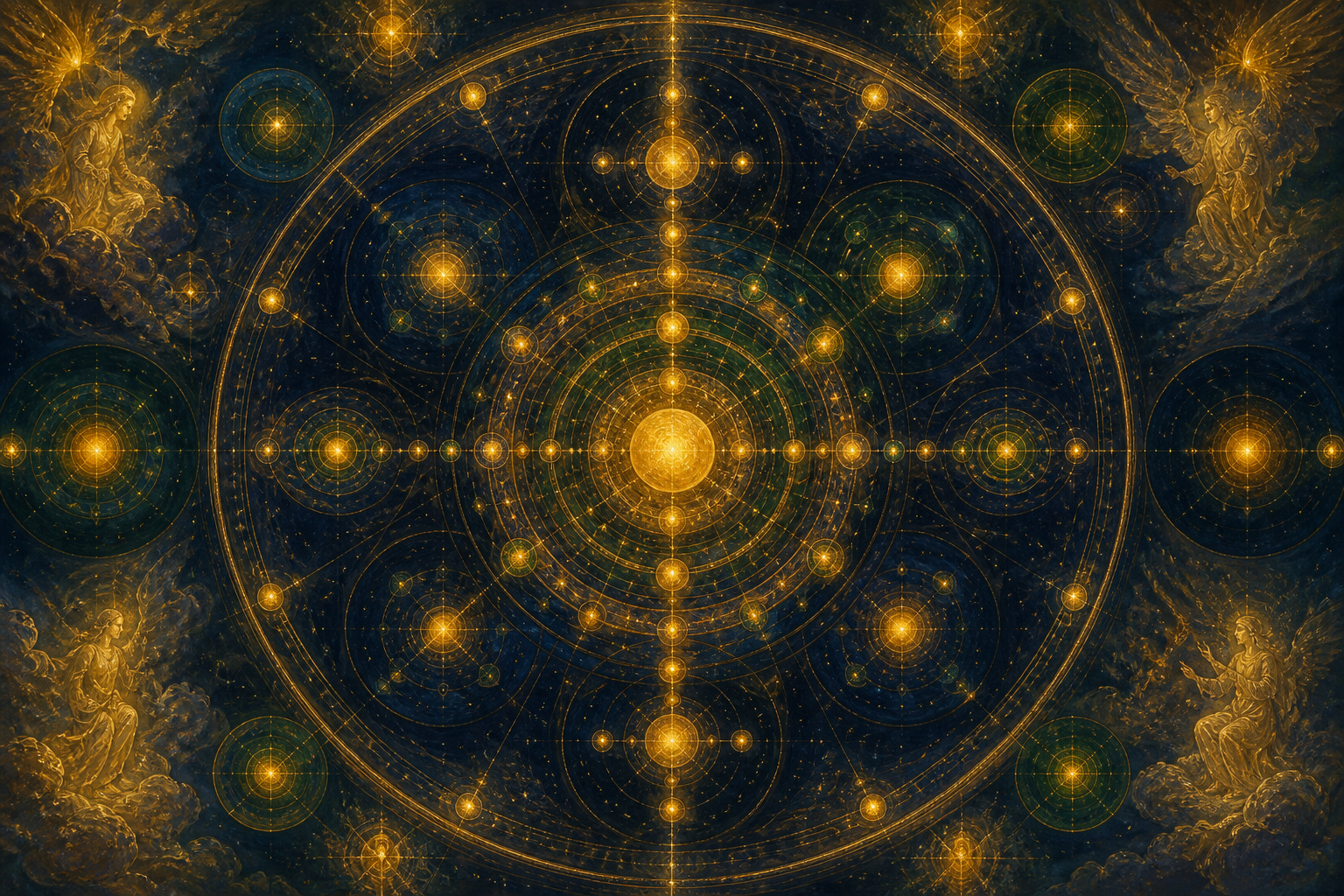
A luminous map of concentric spheres and paired points of light — the fullness of the aeons
The Pleroma — the fullness of the divine aeons.

1.Cosmology Maps: Five Systems Compared

3 min
P1C

Side-by-side visual maps of the Apocryphon of John, the Valentinian Pleroma, On the Origin of the World, the Pistis Sophia cosmos, and the Ophite diagram — showing where they converge and where they genuinely differ.

This volume is the visual companion to the entire Library, and its governing principle must be stated at the outset: there is no single Gnostic cosmology. There are cosmologies — related, overlapping, genuinely different maps of the invisible world, drawn by different communities in different centuries. The great temptation of every previous attempt to chart Gnostic thought has been to harmonize these into one master diagram, and that temptation is exactly what this Atlas refuses. Each system is mapped on its own terms, and the maps are set side by side so the reader can see both the convergences and the real differences (evidence class P1 for each system; evidence class C for the comparison).

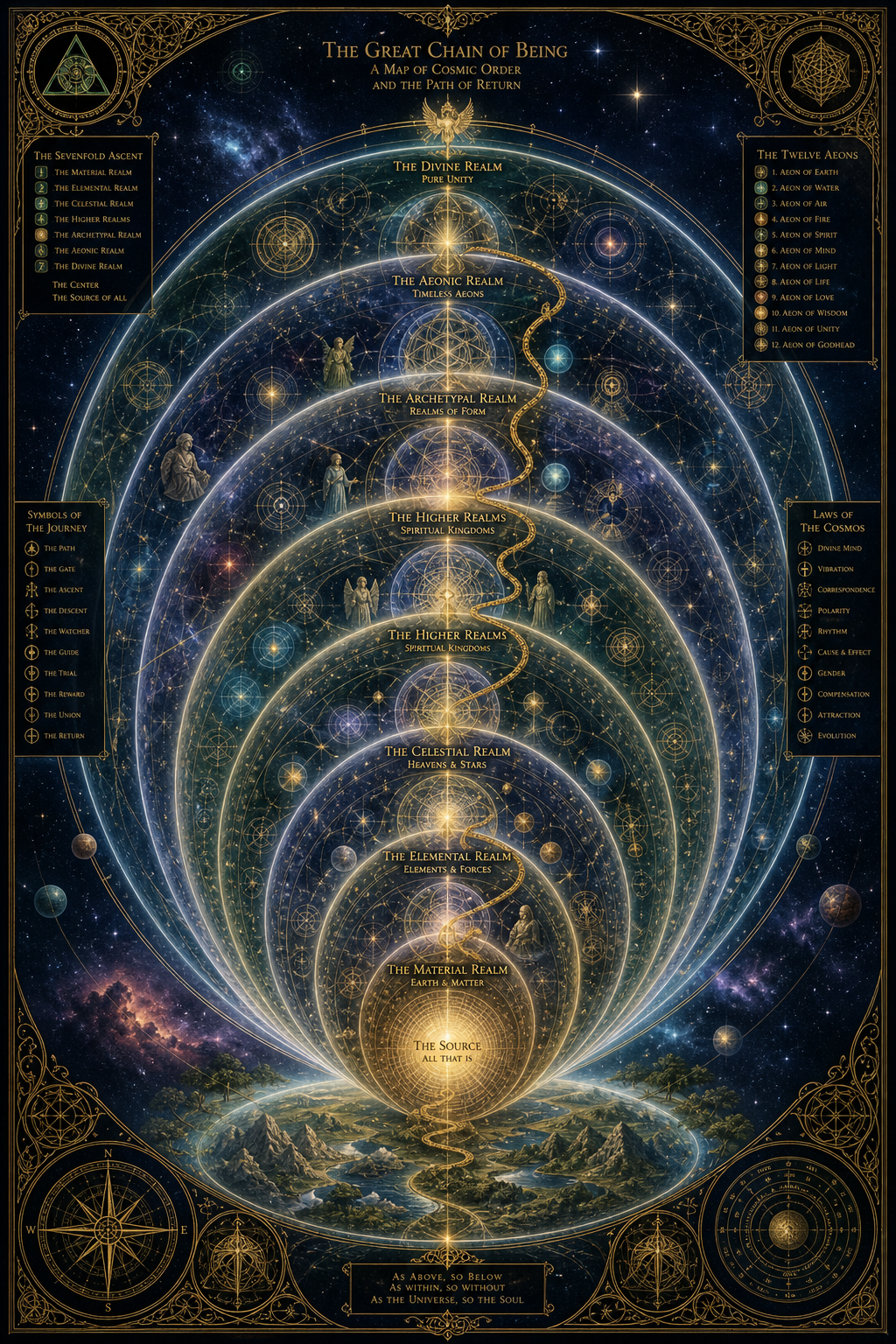
Five systems anchor this opening comparison. The Apocryphon of John gives the fullest Sethian map: the invisible Spirit, Barbelo and the unfolding of the divine world, the four luminaries, Sophia’s fall, and the emergence of Yaldabaoth with his seven and his powers. The Valentinian Pleroma gives a differently structured map: the Depth and Silence, the ordered pairs of aeons unfolding to the Thirty, the passion of Sophia, and the powers of Limit and Christ that restore order. These two are the tradition’s most developed cosmologies, and they do not match in detail even where they rhyme in structure.

On the Origin of the World supplies a third map, closely related to the Sethian but with its own emphases — the extended narrative of Sabaoth’s repentance and elevation, the elaborate account of the rulers’ world. The Pistis Sophia gives a fourth, later and more baroque: a multiplied cosmos of regions, aeons, and orders through which the fallen Sophia must be raised. The Ophite diagram, known only through the hostile description of Origen (and Celsus before him), gives a fifth — a concentric or vertical arrangement of spheres and rulers that we can reconstruct only partially and provisionally (evidence class H for the Ophite reconstruction, since we possess no Gnostic original).

Reading these five side by side, certain convergences stand out and can be asserted with confidence (evidence class P2): all posit an unknowable Source; all place a fullness of divine aeons above; all describe a rupture associated with Wisdom; all interpose a maker-ruler and subordinate powers between the fullness and the human; and all locate a seed of light within the human that grounds the possibility of return. This shared architecture is real and important. But the differences — how many aeons, in what order, with what names, by what mechanism the fall occurs — are equally real, and the Atlas draws them faithfully rather than averaging them away.

A word on how to read the maps in this book. Every diagram in this Atlas uses a consistent visual grammar, explained in each chapter: solid lines for relationships explicitly attested in a primary text; dashed lines for relationships inferred by scholars from the texts; dotted lines for genuinely speculative or reconstructed connections. Colors and shapes are keyed to the evidence classes used throughout the Library. This means the reader can always see, at a glance, how firm the ground is beneath any part of a map — where the tradition speaks plainly, where scholarship reconstructs, and where honest uncertainty remains. The maps are arguments made visible, and their uncertainty markers are part of the argument.
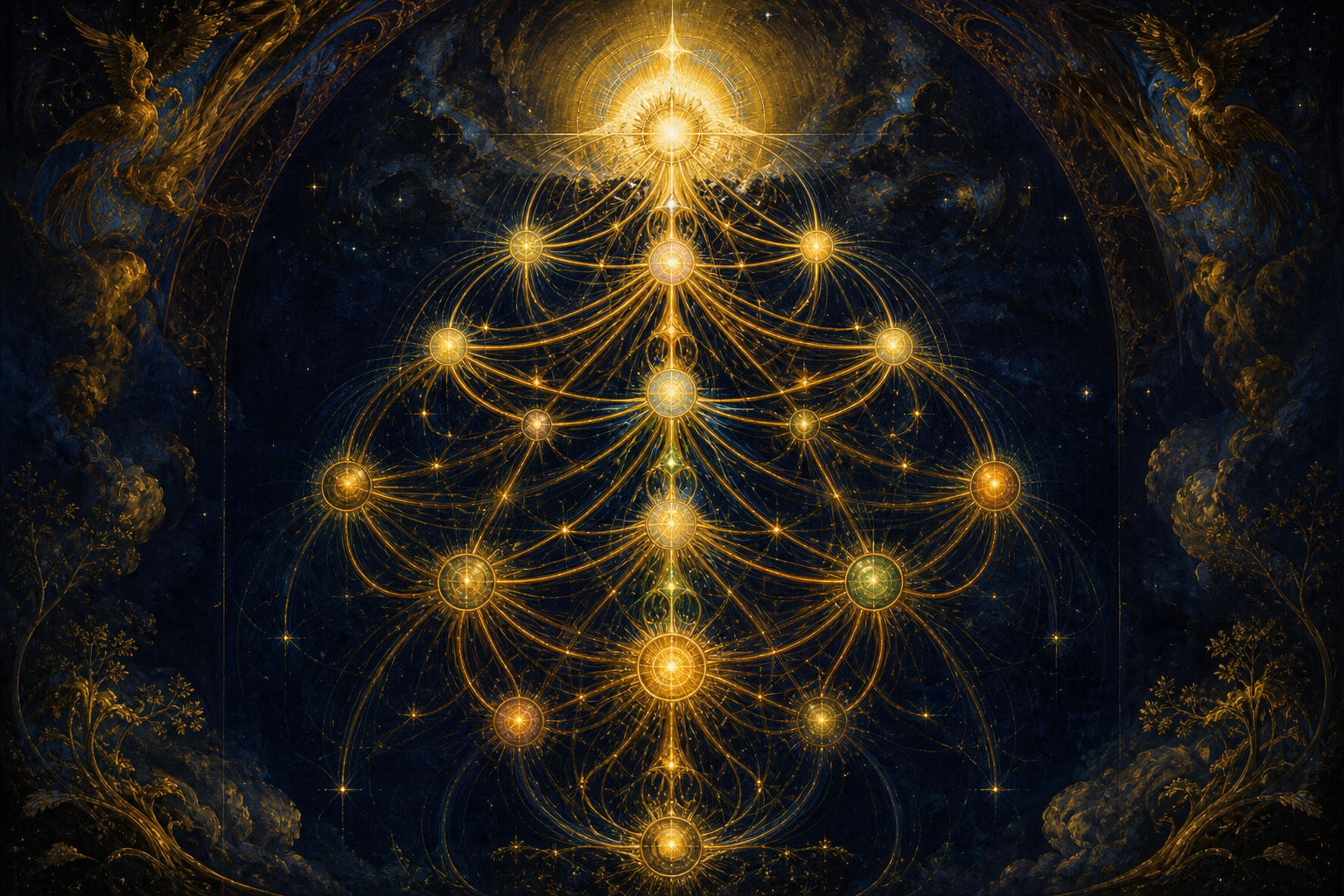
An abstract tree of light: branching gold lines connecting glowing nodes descending from a crown of light
The unfolding — emanation of the aeons from the Source (uncertainty in the outer branches).

2.Aeon Genealogies and Emanation Trees

3 min
P1H

Family trees of the divine aeons with uncertainty markers — solid lines for attested relationships, dashed for inferred, dotted for speculative.

The genealogies of the aeons — the family trees of the divine world — are the subject of this chapter, and they are drawn here with the uncertainty markers that honest scholarship requires. In the fullness, the aeons proceed from the Source not by physical begetting but by emanation, typically in ordered pairs (syzygies) of complementary powers. To diagram these relationships is to make visible the structure of the divine world; to diagram them honestly is to distinguish what the texts state from what we infer (evidence class P1 for the attested relationships; evidence class H for the inferred).

The Sethian genealogy, drawn from the Apocryphon of John and its kin, begins with the invisible Spirit, from whom comes Barbelo (the First Thought), and within Barbelo the unfolding of Foreknowledge, Incorruptibility, Eternal Life, and Truth, and the coming-forth of the divine Autogenes-Son, over whom are set the four luminaries with their attendant aeons — and among the last of these, Sophia. The tree is relatively clear in its upper reaches and grows more complex as it descends. The Atlas draws it with solid lines where the Apocryphon is explicit and dashed lines where the relationships must be inferred from compressed or variant passages.

The Valentinian genealogy is the tradition’s most elaborate and most systematically paired. From the Depth (Bythos) and his consort Silence (Sige) proceeds the pair Mind (Nous) and Truth; from them Word (Logos) and Life (Zoe); from them Human (Anthropos) and Church (Ekklesia); and from these the further aeons completing the Ogdoad, Decad, and Dodecad that make up the Thirty. Sophia is the last of the Thirty, and her passion sets the lower drama in motion. This tree is drawn with confidence in its overall structure (evidence class P1) but with honest notes where the sources — Irenaeus, the Tripartite Tractate, and others — differ on details.

A crucial discipline of this chapter is refusing to merge the Sethian and Valentinian trees into one. They share the pattern of emanation and the placement of Sophia near the boundary, but their internal structures, names, and mechanisms differ substantially, and to graft them onto a single trunk would be to fabricate a unity the tradition never had. The Atlas therefore presents them as separate trees on facing pages, with a comparison chart between them marking where they converge (the unknowable Source, the paired emanation, Sophia’s pivotal position) and where they genuinely diverge (evidence class C for the comparison).

The uncertainty markers are not a scholarly hedge but a truth-telling device, and they carry a lesson beyond genealogy. The Gnostic texts were the scriptures of living communities engaged in ongoing theological reflection, not fixed systems handed down complete; their genealogies grew, varied, and were debated. A map that presented them with false precision — every line solid, every relationship certain — would misrepresent the very nature of the tradition. By drawing dashed and dotted lines where the evidence thins, the Atlas keeps faith with both the reader and the sources, and it models a way of holding sacred material that is at once reverent and honest.

Seven dim ringed planetary spheres arranged as a vertical ladder of rulers and gates
The seven rulers and their heavens — the graded architecture of fate.

3.The Archon Chart

3 min
P1P2

Every named ruler with planetary associations, animal faces, body parts, passions, and functions — organized by source text, never forced into a single harmonized list.

The Archon Chart is the counterpart, in the lower world, to the aeon genealogies of the fullness, and it is the most frequently mishandled diagram in the study of Gnosticism. This chapter presents every named ruler with the attributes the sources assign — planetary association, animal face, body part, passion, and function — organized strictly by source text and never forced into a single harmonized list. The differences among the sources are preserved as data, not smoothed into a false consensus (evidence class P1 for each source’s list; evidence class P2 for the stable core).

The chart’s columns are the sources: the Apocryphon of John, On the Origin of the World, the Ophite diagram as reported by Origen, and the heresiological accounts of Irenaeus and others. Its rows are the rulers. Where the Apocryphon assigns a particular animal face to a particular ruler, that goes in the Apocryphon column; where On the Origin of the World differs, that difference is shown, not overwritten. The reader can thus read the chart either horizontally — following one ruler across the sources to see how the traditions vary — or vertically, reading one source’s complete scheme on its own terms.

Certain features recur across the columns with enough consistency to be marked as the stable core (evidence class P2): a chief ruler (Yaldabaoth) who is lion-faced and serpent-formed; a set of seven associated with the planetary spheres; the assignment of animal faces and bodily/psychic domains; and the identification of the whole apparatus with fate. These convergences are real and are highlighted in the chart. But the specific correspondences — which ruler governs which sphere, wears which face, rules which passion — vary from source to source, and the chart shows every variant rather than choosing a winner.

This chapter also carries forward, in visual form, the fourth volume’s ethical cautions, and they bear repeating because the archon chart is precisely the kind of material that invites misuse. The chart is a map of a mythological structure of domination, presented for understanding. It is not an occult operating manual, not a demonology to be used against real people, and emphatically not a warrant for treating any human being or group as an “archon.” The rulers of the chart are figures of a pattern — psychological, institutional, or (as a religious claim) cosmological — and the chart’s purpose is recognition and liberation, never fear or accusation.

The chart’s deepest lesson is the one the whole Atlas teaches: that the honest representation of the rulers is itself a small act of the liberation the tradition promises. The rulers govern by ignorance and by the false impression of a seamless, total authority. A chart that showed them as one fixed, harmonized system would unwittingly reproduce that false impression of seamlessness. By showing the seams — the disagreements, the variants, the places where the sources plainly differ — the Atlas exposes the constructed and contingent character of the rulers’ order, and thereby does, in the medium of the diagram, exactly what the tradition says knowledge does: it makes the structure visible, and what is truly seen no longer rules unseen.

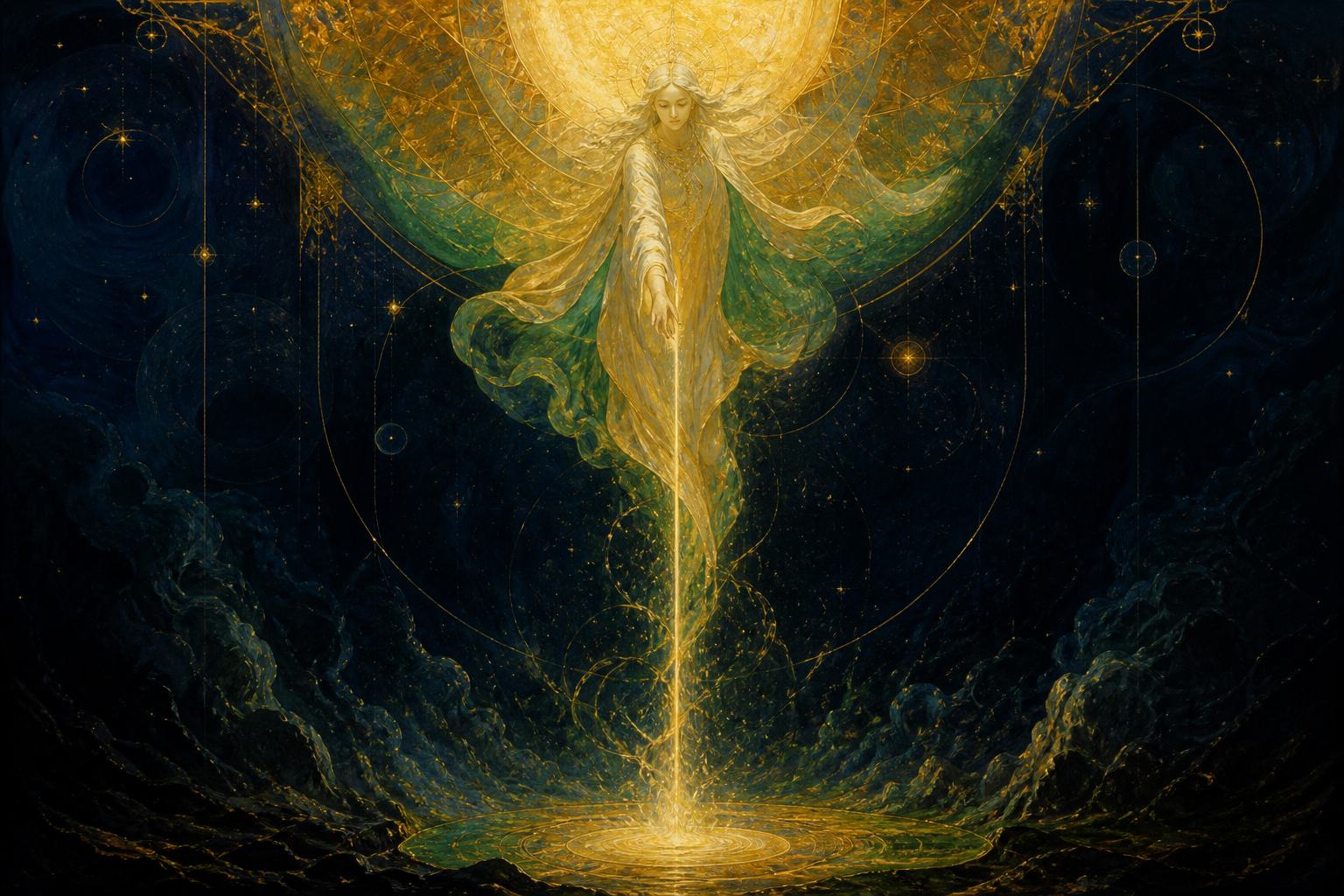
A robed feminine figure of light descending, a trailing ribbon of luminescence falling from the fullness into shadow
Sophia — Wisdom’s reaching and descent from the fullness.

4.The Multiple Descent Timeline

3 min
P2S

A visual timeline tracking First Thought, Sophia, Epinoia, Pronoia/Protennoia, the revealer, and the return — mapping who descends, in what form, and for what purpose in each source.

The Multiple Descent Timeline is the visual heart of this Atlas and the place where the Library’s central interpretive thesis becomes most explicit — and most carefully labeled. It is a diagram that tracks, across the sources, every descent of the divine into the lower world: First Thought, Sophia, Epinoia, Pronoia and Protennoia, the revealer, and finally the return. The claim that these descents form a single, intentional, purposeful pattern is this Library’s synthesis and is marked throughout as such (evidence class S), while the individual descents it charts are attested in the primary texts (evidence class P1 and P2).

The timeline is read left to right as a sequence of movements downward and, finally, upward. First is the emanation and the fall — Sophia’s reaching and the passing of light into the lower world. Then come the successive descents of the light-bearing powers into the forgetting: the Epinoia hidden in Adam, the Pronoia of the great hymn descending three times into the prison of the world, the Protennoia coming in three forms, the revealer descending in a form the sleeping can perceive. Each of these is separately attested; the diagram’s contribution is to place them on a single timeline so their cumulative pattern can be seen (evidence class P1 for each descent).

What the timeline makes visible — and what the ordinary, atomized reading of the texts tends to miss — is that the divine does not descend once but again and again, patiently, into the same darkness. This repeated, persistent movement downward is a genuine feature of the sources, not an invention (evidence class P2 for the pattern of repetition). Where the synthesis enters is in the interpretation of that pattern: the intentional-descent thesis proposes that the repetition is purposeful — that the light goes down not merely to salvage what was lost by accident but as a chosen, sustained mission of recovery and, ultimately, of return-with-knowledge.

The diagram is scrupulous about marking the boundary between attestation and synthesis, and it does so visually. The descents themselves are drawn as solid elements, keyed to their source texts. The interpretive overlay — the reading of the whole as a single intentional strategy, the arrows of purpose connecting the descents into a coherent mission — is drawn in a distinct visual register explicitly labeled as the Library’s synthesis (class S). A reader who accepts only the solid elements has the attested pattern of repeated descent; a reader who follows the overlay has the intentional-descent interpretation, clearly flagged as an interpretation to be weighed rather than a fact to be received.

This chapter states, as plainly as the whole Library states it, what the intentional-descent thesis is and is not. It is a reading the texts permit and richly reward — illuminating the persistence of the descending divine, the language of seeding and recovery, the note of purpose that runs alongside the note of tragedy. It is not the plain, undisputed teaching of the ancient sources, several of which read the initial descent straightforwardly as fall and deficiency. The Atlas draws the thesis because it is powerful, hopeful, and the founder’s own considered synthesis; it labels the thesis because honesty requires it; and it invites the reader, at this the most consequential diagram in the book, to weigh the overlay for themselves.

An abstract tree of light: branching gold lines connecting glowing nodes descending from a crown of light
The unfolding — emanation of the aeons from the Source (uncertainty in the outer branches).

5.Genesis Reversal Diagrams

3 min
P1C

Visual diagrams showing how each Gnostic school reverses, reinterprets, or transforms the Genesis narrative — creation, fall, serpent, trees, flood, and tower.

The Genesis Reversal Diagrams chart one of the most distinctive and easily misunderstood features of Gnostic thought: its systematic rereading of the opening chapters of Genesis. Across the schools, the creation narrative is not rejected but re-interpreted — its valences reversed or transformed — so that elements the conventional reading treats as good or evil trade places. This chapter diagrams those reversals school by school, because they do not all reverse the same elements in the same way (evidence class P1 for the primary rereadings; evidence class C for the comparison across schools).

The central reversal concerns the creator and the prohibition. Where the conventional reading sees a good creator issuing a wise prohibition against the Tree of Knowledge, several Gnostic texts see an ignorant ruler forbidding knowledge precisely to keep the human asleep — so that the counsel to eat becomes, in these readings, a step toward gnosis rather than a fall into sin. The serpent, correspondingly, is revalued in some texts as an agent of awakening (the Naassenes took their very name from the serpent), though the schools differ, and not every Gnostic text embraces the serpent (evidence class P1 for the revaluation; class U for how widely it was held).

The figure of Eve undergoes a parallel transformation. In her spiritual aspect, identified with Zoe (Life) and with the luminous Epinoia, Eve becomes the bearer of awakening intelligence — the one through whom the light’s instruction reaches Adam — rather than the occasion of the fall. The diagrams distinguish carefully between the spiritual Eve (the awakening principle) and the earthly Eve of the ruler’s world, since the texts operate with exactly this kind of doubling, and collapsing the two produces confusion. Adam, likewise, is diagrammed in his heavenly and earthly registers (evidence class P1).

Beyond the garden, the reversals extend to the flood and the tower. In several texts the rulers send the flood to destroy the enlightened seed, and figures like Norea resist the rulers’ designs — inverting the conventional reading in which the flood is divine justice. These extended reversals are diagrammed with the same source-by-source discipline, showing which text reverses which element, because the schools were not uniform: some rework the whole primeval history, others touch only the garden. The Atlas resists the impulse to present “the Gnostic reading of Genesis” as a single thing, because there was no single thing (evidence class C).

A necessary caution governs this chapter, and it is a matter of the Library’s editorial conscience. The Gnostic reversal of Genesis is a sophisticated hermeneutical move — a critique of a certain image of God and a certain account of knowledge and obedience — and it is presented here as such, as ancient theological interpretation. It is not presented as a refutation of Judaism or of the Hebrew scriptures, and any reading that would weaponize these reversals into contempt for Jewish tradition or scripture is a distortion this Library explicitly rejects. The reversals are diagrammed to be understood in their own ancient context, as the daring exegesis of communities wrestling with the deepest questions of origin, knowledge, and the goodness of the world.

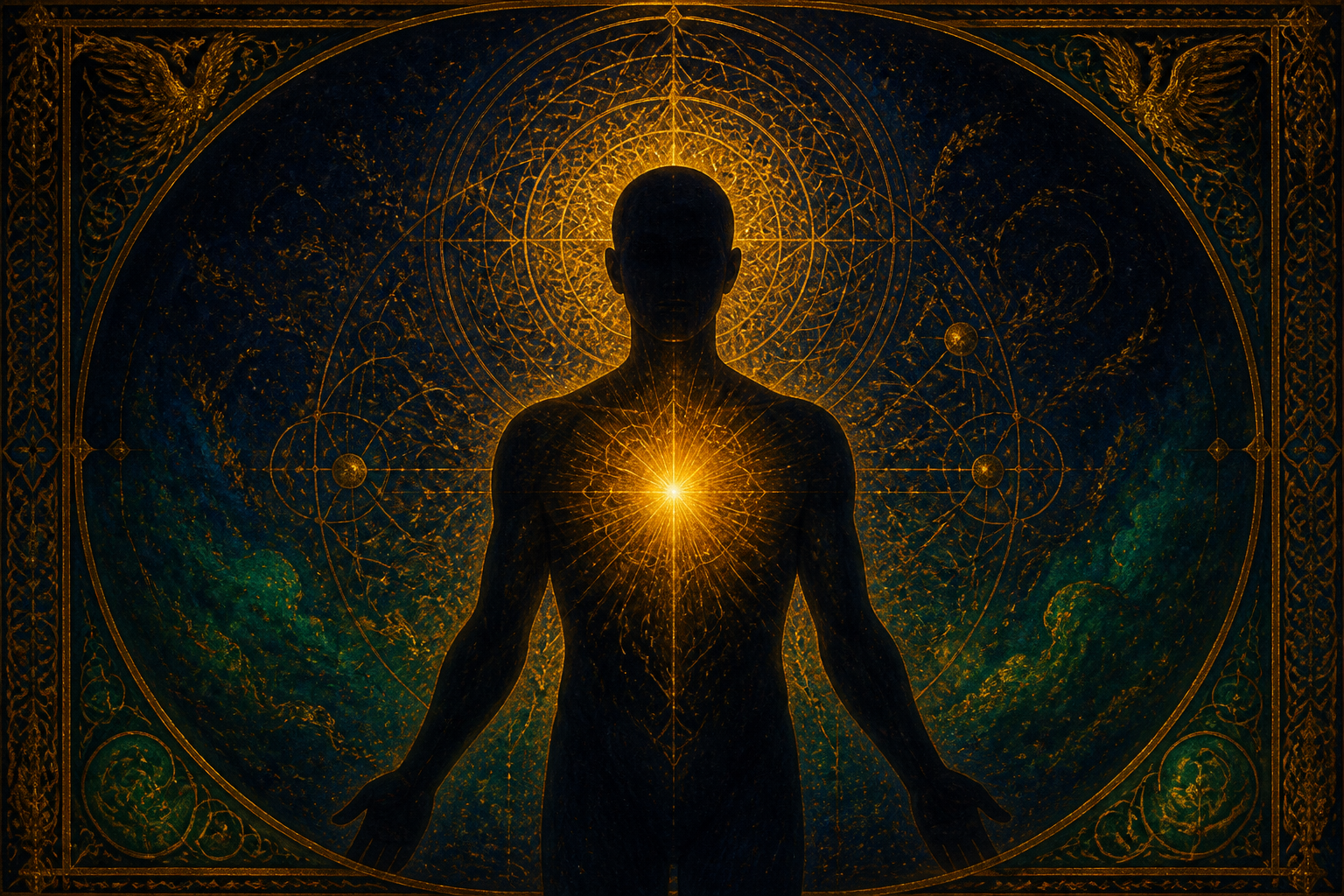
A human silhouette in darkness with a single golden seed of light glowing at the center of the chest
The seed of light — the imperishable spark the rulers cannot create or destroy.

6.Human Composition Maps

3 min
P1C

Body, soul, spirit, counterfeit spirit, seed, passions, faculties, and organs — as described by different texts. The human being as a contested territory.

The Human Composition Maps turn from the cosmos to the microcosm — to the Gnostic anatomy of the human being, who is, in this tradition, a contested territory where the rulers’ fabrication and the divine seed coexist and struggle. This chapter diagrams how the different texts compose the human out of body, soul, spirit, counterfeit spirit, seed, passions, and faculties, and it shows that the schemes, while related, are not identical (evidence class P1 for each scheme; evidence class C for the comparison).

The broad structure common to most schemes distinguishes several layers: the material body, fashioned by the rulers; the soul, the animating psychic principle, itself often described as the rulers’ work; the spirit or seed of light, the imperishable divine portion; and the counterfeit spirit, the false inner counterpart installed to imitate the true spirit and hold the soul in forgetting. The human is thus a layered being, part fabrication and part light, and the drama of salvation is played out precisely in the relation among these layers (evidence class P1 for the layered structure).

The Valentinian tradition adds a further and influential distinction — the threefold typology of the material (hylic), the psychic, and the spiritual (pneumatic) — describing three orientations or conditions of human beings in relation to the light. This scheme has been badly misread as a doctrine of fixed, deterministic classes of humanity, some saved by nature and others damned by nature. The Atlas diagrams the threefold scheme while flagging this misreading directly: the better scholarship understands the types as conditions or orientations rather than immutable castes, and the deterministic reading is both contested and ethically corrosive (evidence class P1 for the typology; class U and a strong caution for the deterministic interpretation).

The maps assign the passions and faculties to their places within the human composite, following texts like the longer Apocryphon of John, which describes in remarkable detail the fashioning of the psychic body and the assignment of powers to its parts. These passages read almost as an ancient psychosomatic anatomy — an attempt to map how reactivity, appetite, and forgetting are seated in the human being. The Atlas diagrams them as what they are: the tradition’s own detailed account of how the rulers’ control is embodied, and therefore of where the work of liberation must be done (evidence class P1).

The chapter closes by drawing out the hope encoded in the maps, and by repeating the Library’s ethical guardrails. However the layers are drawn, every scheme places within the human a seed of light that the rulers did not make and cannot destroy — which means the deepest truth about any person is not their fabrication, their conditioning, or their type, but the light they carry and may remember. And the maps of body and passion are offered for understanding and liberation, never as a rationale for contempt of the body or neglect of its care: the recognition that embodied life can muffle the light is not license to harm the body, and this teaching is never a substitute for medical or psychological care. The human being, in this Atlas, is a contested territory — but the outcome the tradition promises is recovery, not ruin.

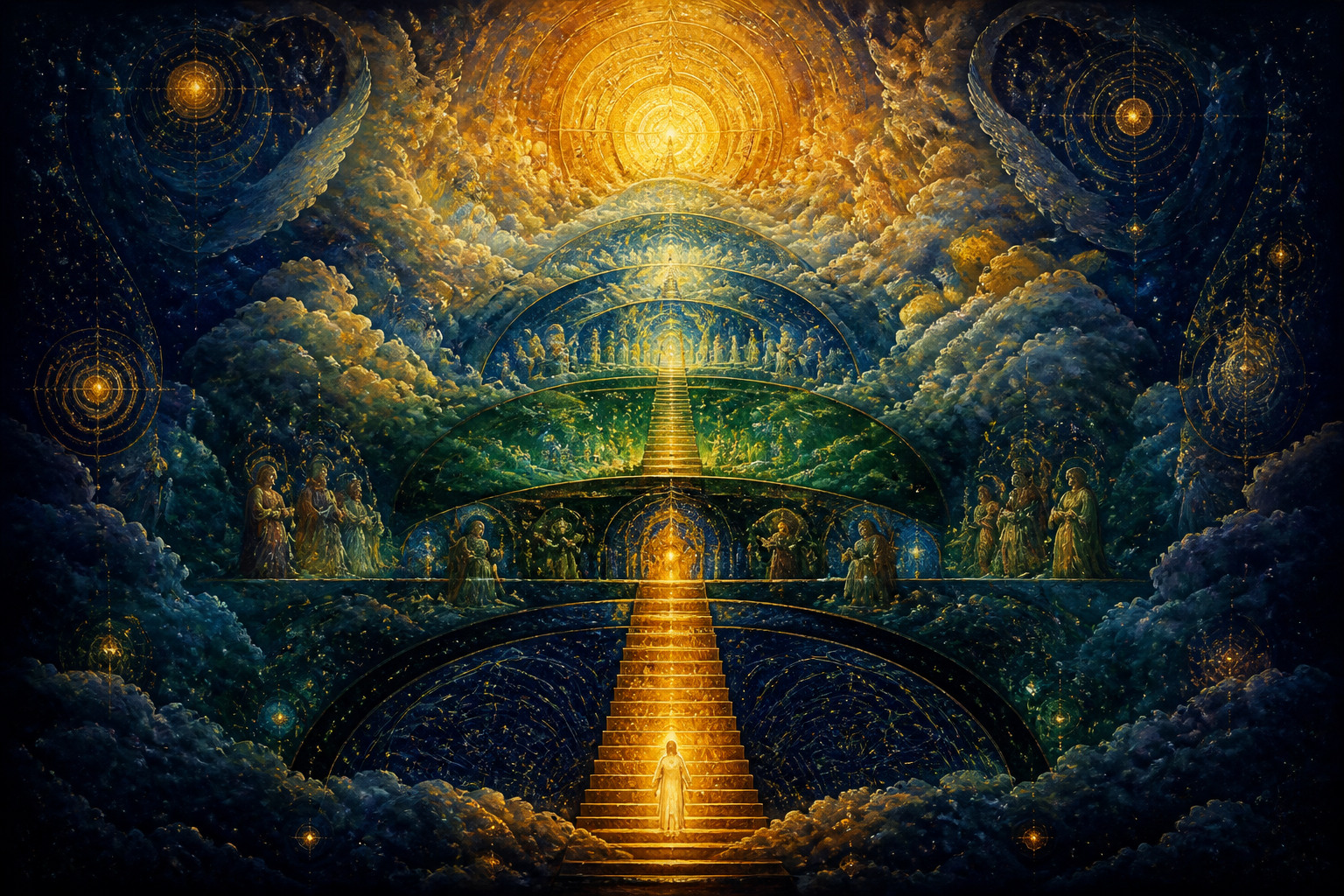
A small figure of light ascending a luminous stair rising through layered heavens toward a radiant summit
The ascent — the soul’s return home through the heavens.

7.Ascent Maps and Ritual Pathways

3 min
P1H

Visualizations of ascent through the heavens — passwords, seals, and responses — drawn separately for each source text, never merged without clear warning.

The Ascent Maps diagram the soul’s return journey — the passage back up through the heavens by which it descended — and they are drawn, once again, separately for each source, because the tradition’s ascent literatures differ too much to be merged without falsification. This chapter charts the passwords, seals, and responses of the ascent as three distinct maps: the visionary ascent of Zostrianos, the ritual passwords of the Books of Jeu, and the devotional ascent of the Pistis Sophia (evidence class P1 for each; a clear warning attached to any merging).

The Zostrianos map is drawn as a graded ascent through named levels of reality — baptisms and instructions received at each, the seer transformed as he rises toward the Barbelo-aeon and the invisible Spirit. It is an ascent of progressive initiation, and the map marks each level as a station of teaching rather than merely a gate to be passed. Because the text is fragmentary and philosophically dense, portions of the map carry uncertainty markers, and the Atlas is explicit about where the reconstruction of the sequence is secure and where it is inferred (evidence class P1 shading to H).

The Books of Jeu map is drawn as a sequence of gates, each with its guardian, its required name, its seal, and its password. This is the ascent as ritual knowledge: to rise, the soul must know at each threshold the correct name and defense, or be turned back. The Atlas reproduces the structure of this gated ascent — the seals and names as the texts give them — while stating clearly that it presents this as the tradition’s own account of the ascent, a map of a mythic-ritual journey, and not as an operational procedure that a modern reader should expect to perform or that “works” in any literal mechanical sense (evidence class P1 for the material).

The Pistis Sophia map is drawn differently again — as an ascent powered by repentance and longing rather than by passwords. The fallen Sophia is raised, stage by stage, as she sings her repentances and turns her desire toward the light. The map charts her regions and her successive elevations, representing the ascent as a transformation of the heart. That the same tradition can figure ascent as visionary initiation, as ritual password-knowledge, and as the reorientation of longing is itself the point: the maps are three, and the Atlas keeps them three (evidence class C for the comparison).

The warning that governs this chapter is the one the whole Atlas exists to enforce: never merge the ascent maps into a single composite route. Each belongs to a particular text and community, with its own logic, and a merged “master ascent” would be a modern fabrication wearing ancient dress — exactly the counterfeit authority the Library is built to refuse. The maps are set side by side, their differences preserved, so the reader can see the tradition’s genuine plurality. What they share — that return is real, that it passes back through the structures that bound the soul, and that it transforms the soul as it rises — is drawn as their common horizon, but their routes remain, honestly, their own.

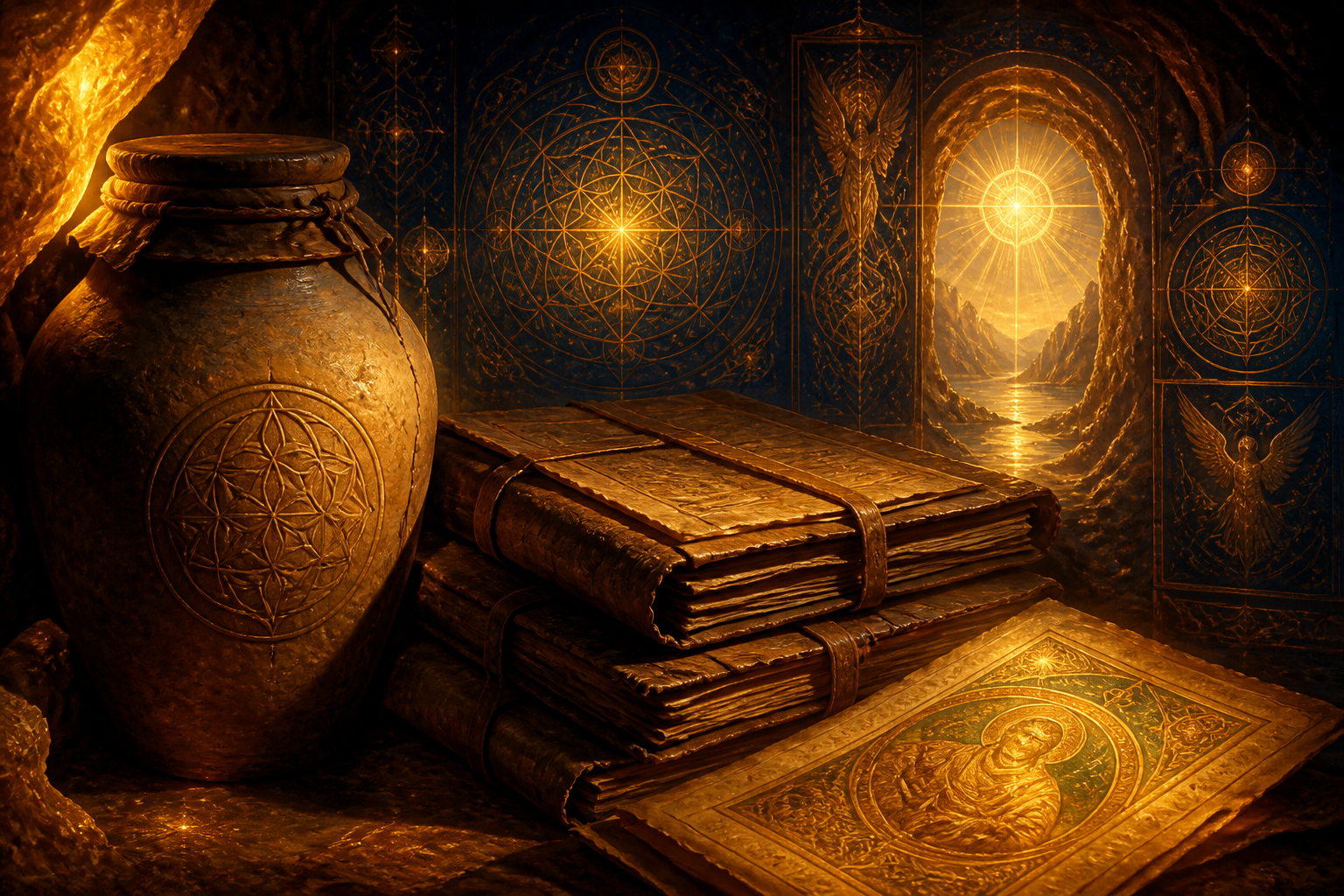
An ancient sealed clay jar and stacked leather-bound papyrus codices in warm desert cave light
The recovered witness — the Nag Hammadi codices, the tradition’s own voice restored.

8.Manuscript Timeline

3 min
H

Discovery, codex, language, and transmission timeline — from the Nag Hammadi find through the Berlin Codex to modern critical editions.

The Atlas closes not with the invisible world but with the visible history of how we came to know it — the Manuscript Timeline, which charts the discovery, codices, languages, and transmission of the texts on which everything in this Library depends. This final chapter is a diagram of evidence itself: a visual account of the fragile material chain by which these ancient writings survived to be read, and therefore of the ground on which every other map in the book stands (evidence class H throughout, this being historical reconstruction from manuscript and archaeological evidence).

The timeline’s pivotal event is the discovery, near Nag Hammadi in Upper Egypt in 1945, of a sealed jar containing thirteen leather-bound codices — some fifty-two tractates in Coptic, most of them Gnostic, most previously unknown or known only by title from the heresiologists. The map traces the circumstances of the find, the codices’ subsequent dispersal and partial loss, their eventual acquisition and study, and the decades-long labor of editing, translating, and publishing that made the tradition’s own voice available for the first time in roughly sixteen centuries (evidence class H).

Before Nag Hammadi, the timeline shows a much thinner chain. A few Gnostic works survived in earlier manuscript witnesses — the Berlin Codex (Papyrus Berolinensis 8502), preserving the Gospel of Mary, an Apocryphon of John, and the Sophia of Jesus Christ; the Askew Codex, preserving the Pistis Sophia; the Bruce Codex, preserving the Books of Jeu. Behind these Coptic manuscripts lie Greek originals, now mostly lost, composed in the second, third, and fourth centuries. The map draws this transmission as a chain narrowing backward in time, with the losses honestly marked (evidence class H).

The timeline also charts the other, older witness: the heresiological reports of Irenaeus, Hippolytus, Epiphanius, Clement, and Origen, written from the second century onward by opponents of the Gnostics. For centuries these hostile summaries were nearly the only source, and the map shows both their value — they preserve systems and details we would otherwise have lost — and their limitation, since they were written to refute. One of the striking findings the timeline records is how often the Nag Hammadi texts, when finally read, confirmed that the heresiologists had reported real teachings with more accuracy than skeptics had assumed (evidence class H, upgraded toward P2 where the codices corroborate the reports).

The Atlas ends, fittingly, by pointing beyond itself to these sources. Every map in this book — every cosmology, genealogy, archon chart, descent timeline, and ascent map — rests finally on this fragile, recovered chain of manuscripts and on the disciplined scholarship that reads them. The uncertainty markers throughout the Atlas are ultimately expressions of the manuscript situation this last chapter diagrams: where the texts are clear and well-attested, the lines are solid; where they are fragmentary, variant, or dependent on hostile summary, the lines are dashed or dotted. The final invitation of the whole Library is the one this timeline makes concrete — to go to the primary texts themselves, now available as they were not for sixteen hundred years, and to meet the tradition, at last, in its own recovered voice.

Key Primary Sources

Apocryphon of John
On the Origin of the World
Pistis Sophia
Books of Jeu
Ophite diagrams (per Irenaeus/Hippolytus)
Valentinian reports
Zostrianos
Nag Hammadi Codices I–XIII

Search this book

Ask a question or enter a topic and this finds the exact passages in the text that answer it — quoted word-for-word with their source chapter. It searches the book’s real content, so it’s instant, always available, and free to use. Ask as many follow-ups as you like.

Try searching for:

Results are drawn only from the Library’s published text. Do not substitute spiritual practice for medical or mental-health care.